What Is AI Integration and How Can It Actually Help Your Business in 2026?

In 2026, the biggest business risk isn't failing to adopt AI. It's adopting AI the wrong way.
Here we’ll see what that actually looks like in practice.
A business owner sees competitors talking about AI. The budget gets approved. A tool gets purchased. The team uses it a few times, then stops. Six months later, nothing has changed except the invoice. Leadership quietly agrees, "AI wasn't right for us yet," and moves on.
Most people blame the technology. The real problem was never the AI. The real problem was that nobody agreed on what problem it was supposed to solve.
So What Does "AI Integration" Actually Mean?
Your business already runs on a set of workflows, like how orders get processed, how customers get supported, and how your team reports on performance. AI integration means building intelligence directly into those workflows, so they get faster, smarter, and less dependent on manual effort.
Not a standalone tool that your team has to remember to open. Not a chatbot bolted onto your website. Something that works inside the systems you already use, on the data you already have.
When AI integration services are done right, you don't feel like you've added something new. You feel like you've finally fixed something that's been slowing you down for years.
Why Do So Many AI Projects Quietly Die?
Here's a number worth pausing on: 78% of businesses have adopted AI in some form. Yet 70–85% of those projects fail to deliver real, measurable results.
Because businesses are skipping the most important step, figuring out what they're actually trying to fix before buying anything.
The sequence matters more than the tool. Every time.
Most AI projects die because:
A tool gets purchased before a problem gets clearly defined
Nobody asks which workflows are actually eating the most time or money
The team uses it inconsistently, and it quietly gets deprioritized
The verdict becomes "AI didn't work for us."
Where AI Integration Actually Moves the Needle
Skip the theory for a moment, and here's where it shows up in real business scenarios.
Your Operations Team Is Doing Work a Machine Should Be Doing
Pick any back-office function: invoice processing, dispatch reconciliation, onboarding paperwork, or compliance reporting. Somewhere in your business, smart people are spending hours every week on tasks that follow a predictable pattern.
Automation for businesses at this level isn't glamorous. But it's where the ROI shows up the fastest. Companies that automate even one high-volume workflow typically cut processing time by 30–50% within the first quarter.
A real scenario: A logistics company was spending 12 hours a week manually reconciling dispatch records. After AI automation, it ran overnight. Flagged exceptions landed in a human reviewer's inbox each morning. The team didn't notice the change in workload; they noticed it in their calendar.
Your Customer Support Can't Keep Pace With Growth
Your team is capable. But they can only handle so many conversations at once. As your business grows, the gap between what customers expect and what your team can deliver gets wider and more expensive.
Generative AI integration enables you to deploy intelligent support systems that handle high-volume, low-complexity queries, such as order status, FAQs, and escalation routing, allowing your team to focus on the conversations that require judgment and empathy.
This isn't a generic bot that frustrates customers. It's a system trained on your products, your tone, and your actual customer history. The difference is noticeable from the first interaction.
You're Making Big Decisions on Yesterday's Data

Most founders and CEOs are running on reports that are 48–72 hours old by the time they read them. By then, the window has often already closed.
AI software development can embed predictive intelligence directly into the tools your team already uses, flagging risks before they become crises and surfacing demand signals before your competitors act on them. You stop being reactive. You start moving first.
You Want to Grow Revenue Without Growing Headcount at the Same Rate
With the right business AI solutions in place, your business can handle more customers, more transactions, and more operational complexity without hiring proportionally to match. The AI absorbs the volume. Your people handle what needs human judgment.
Nobody gets replaced. You just stop hiring people to do things machines do better.
The Mistake That Costs Business Owners the Most
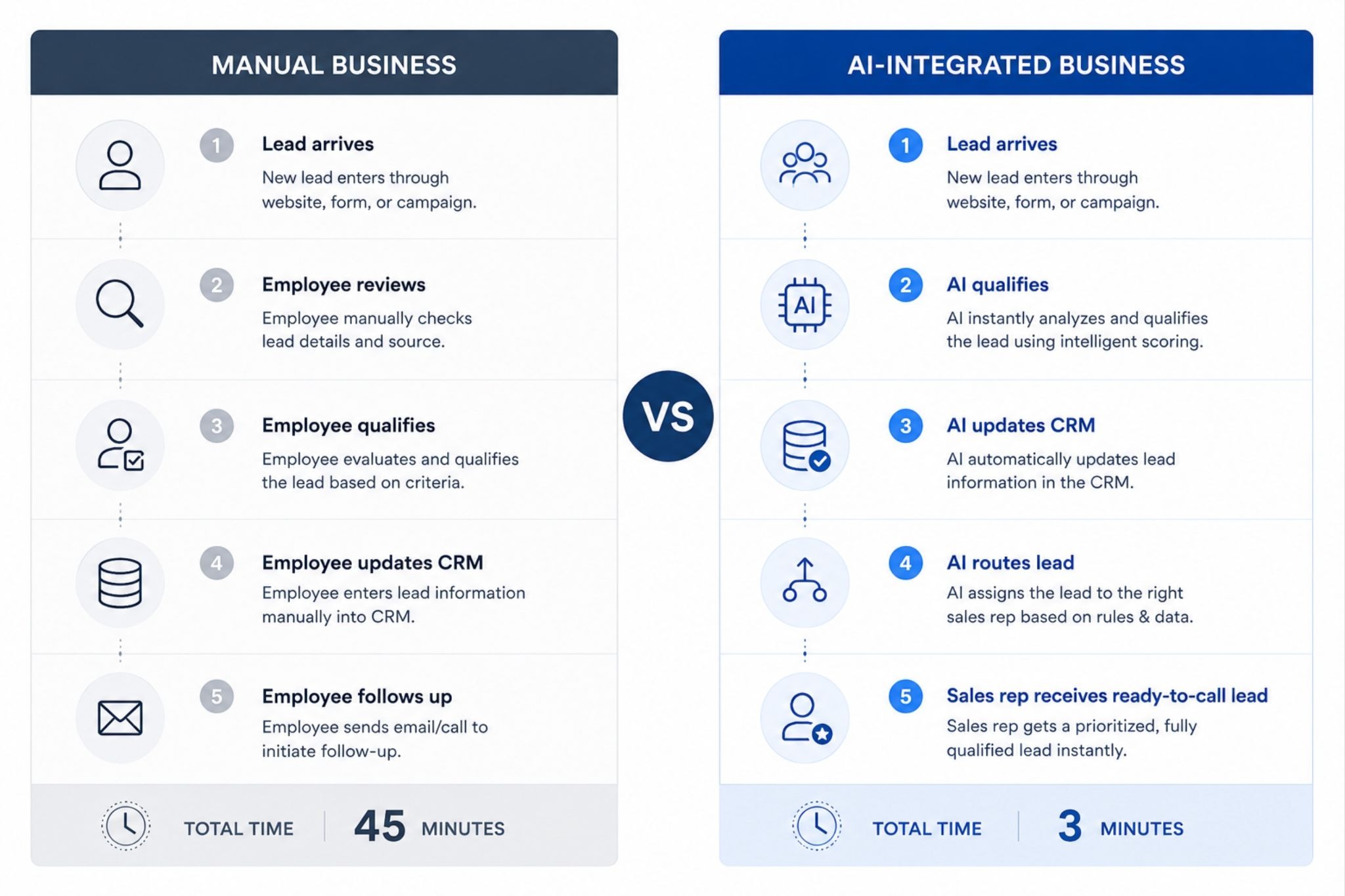
Confusing an AI tool with AI integration.
A tool is something your team logs into when they remember to. Integration is something that runs inside your business, whether anyone thinks about it or not.
Subscribing to an AI writing platform is a tool. Building an intelligent system that scores your inbound leads, routes them to the right sales rep, and updates your CRM automatically, that's integration.
True AI integration services connect to your existing stack, learn from your actual data, and operate inside your real workflows.
Before committing budget to any AI initiative, answer these three questions honestly:
What specific problem are we solving?
Which team or workflow owns that problem?
How will we measure success in 90 days?
If any of those answers are vague, you're not ready to build yet. You're ready for a strategy conversation first.
What Before and After Actually Look Like
Here's an honest snapshot across three common business functions:
Business Function | Before AI Integration | After AI Integration |
Customer Support | 200+ tickets/day, 8-hour avg response | AI handles 60% of queries, responds within 2 minutes |
Finance Operations | Manual reconciliation, weekly reporting delays | Automated matching, real-time dashboards |
Sales Pipeline | Reps manually chasing and qualifying every lead | AI scores and prioritizes; reps spend time closing |
None of this requires a year-long transformation project. It starts with one workflow. You prove the ROI. Then you expand.
What Role Does Generative AI Actually Play Here?
Generative AI is one layer within the broader AI integration stack. And probably the most overhyped one right now.
Used carefully, generative AI integration helps your business produce content at scale, build internal knowledge tools, generate smart document summaries, and create personalized customer communications, without a team of writers doing it all manually.
But without a clear scope and proper governance, it becomes expensive noise fast. The businesses seeing real results from generative AI aren't the ones who deployed it the fastest. They're the ones who scoped it the most carefully.
A broader look at why enterprise leaders are investing in AI software development in 2026 is worth your time.
How to Start Without Burning a Budget
Keep it specific. Keep it small. Measure everything.
Step 1 - Find your most painful workflow. The one that's quietly eating hours every week across your team.
Step 2 - Define what success looks like. Hours saved. Cost per transaction. Error rate reduced. Pick one number and commit to it before you start.
Step 3 - Build a focused solution. A targeted fix for the specific problem you identified in step one.
Step 4 - Measure for 60–90 days. If it works, expand. If it doesn't, adjust before you scale the wrong thing.
If you want a clearer picture of the consulting-first approach before committing to a build, this guide on how AI consulting services help businesses save time and reduce costs is a practical starting point.
And here's where the partner you choose matters.
Anyone can build something and hand it over. The question is whether they're still invested six months after launch, when the real-world edge cases show up, and the initial scope needs to evolve.
At Softuvo, we start with strategy before we write a single line of code. Because software built without a clear outcome in mind almost always needs to be rebuilt.
Have a workflow in mind? Let's talk about it.
FAQs
Q: Is AI integration only for large enterprises?
Not at all. You don't need to be enterprise-scale to benefit; you just need a real problem worth solving.
Q: How long before you see results?
A well-scoped integration can go live in 6–12 weeks. Larger programs typically run 3–6 months in phased rollouts.
Q: Does AI integration replace your existing software?
Usually not. Most integrations are built to connect with what you already use: your CRM, ERP, helpdesk, or finance tools. It adds intelligence to them, not a replacement layer on top.
Q: What's the real difference between automation and AI integration?
Traditional automation follows rules you set in advance. AI integration learns from your data, adapts when things change, and handles exceptions that would break a rule-based system.
Q: How do you know if your business is ready?
If you have a repeated pain point, data that tracks it, and a team that's open to working differently, you're ready to start. You just need a clear problem and the honesty to name it.