Intelligent Automation in Banking: The Complete Guide to Benefits, Use Cases & Implementation
The banking industry has entered a new era where customers expect instant services, personalized experiences, and secure digital transactions. Traditional banking processes that once relied on manual work are no longer enough to meet these expectations.
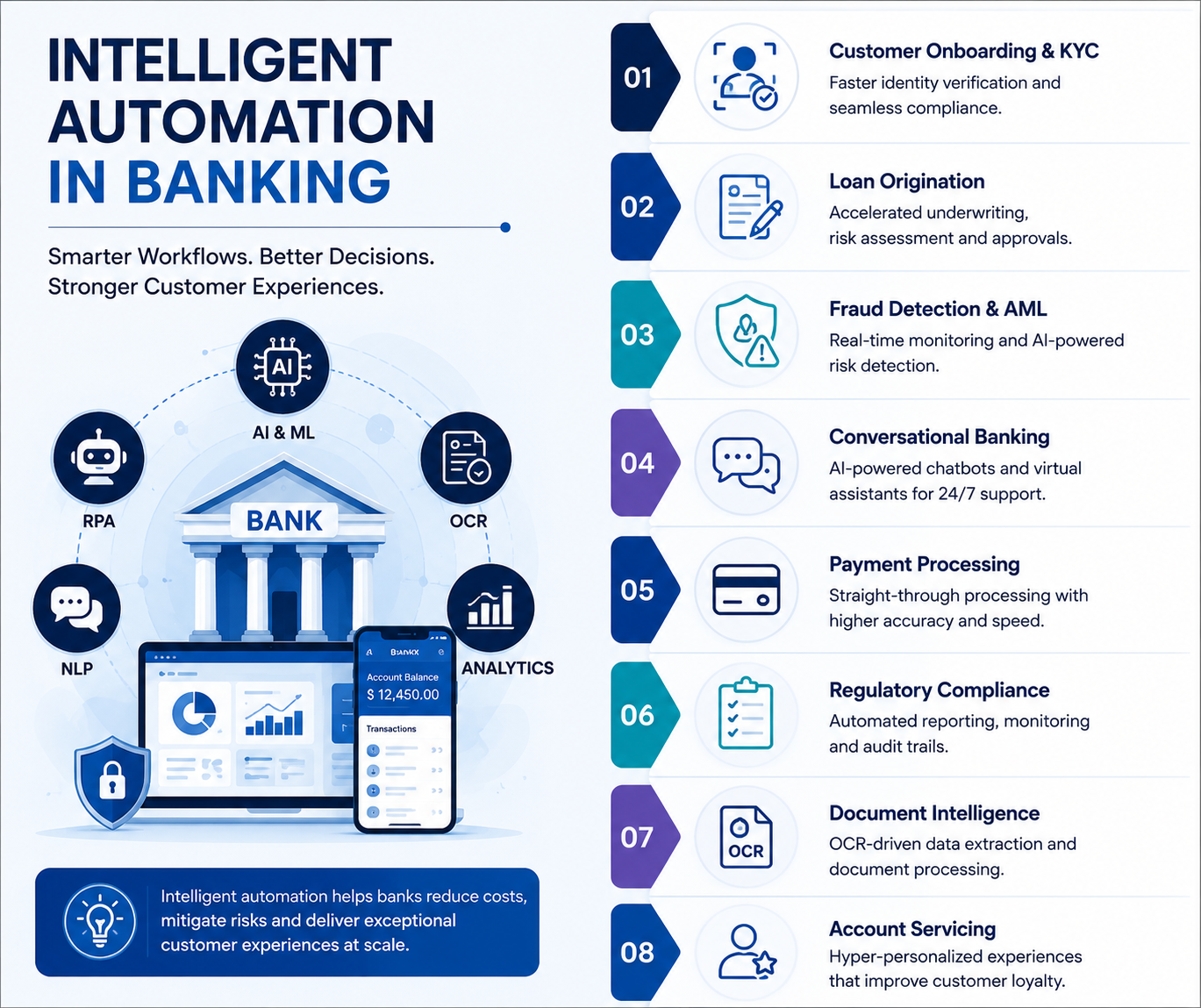
This is where Intelligent Automation in Banking is transforming financial institutions. By combining Artificial Intelligence (AI), Robotic Process Automation (RPA), Machine Learning (ML), Optical Character Recognition (OCR), and analytics, banks can automate complex workflows while improving decision-making and customer experiences.
From loan processing and fraud detection to customer onboarding and compliance, intelligent automation is helping banks become faster, smarter, and more efficient.
In this guide, you'll learn what intelligent automation in banking is, its benefits, real-world use cases, implementation strategies, and how financial institutions can successfully embrace digital transformation.
What is Intelligent Automation in Banking?
Intelligent Automation in Banking refers to the combination of AI-powered technologies and automation tools that streamline banking operations with minimal human intervention.
Unlike traditional automation that follows fixed rules, intelligent automation can:
Learn from historical data
Understand documents
Make predictions
Detect fraud patterns
Automate repetitive decisions
Continuously improve processes
Banks are increasingly using AI in banking to automate routine tasks while allowing employees to focus on higher-value customer interactions.
Why Banks Are Investing in Intelligent Automation
Today's banking customers expect:
Instant account opening
Faster loan approvals
24/7 customer support
Secure online transactions
Personalized financial recommendations
Meanwhile, banks face challenges such as:
Rising operational costs
Regulatory compliance
Fraud prevention
Legacy systems
Increasing competition from fintech companies
Banking workflow automation helps financial institutions solve these challenges while delivering better customer experiences.
Key Technologies Powering Intelligent Banking Solutions
Modern banks are becoming faster, smarter, and more customer-focused by combining several advanced technologies. Together, these technologies help automate routine work, improve decision-making, strengthen security, and deliver better customer experiences.
Artificial Intelligence (AI)
Artificial Intelligence is at the heart of intelligent banking solutions. It helps banks analyze vast amounts of customer and financial data, identify patterns, and make faster, more accurate decisions.
Some of the most common AI applications in banking include:
Detecting fraudulent transactions in real time
Improving credit scoring and loan approvals
Delivering personalized product recommendations
Powering AI-driven customer support
Enhancing risk assessment and compliance
Robotic Process Automation (RPA)
Robotic Process Automation takes over repetitive, rule-based tasks that traditionally require manual effort. By automating these workflows, banks can reduce errors, improve efficiency, and free employees to focus on more valuable work.
RPA is widely used for:
Entering and updating customer data
Processing transactions
Managing account information
Generating financial reports
Preparing compliance and audit documentation
Machine Learning
Machine Learning allows banking systems to become smarter over time by learning from historical data and customer behavior. As more data becomes available, the system continuously improves its predictions and recommendations.
Banks use machine learning for:
Predicting loan repayment risks
Detecting unusual or fraudulent activities
Segmenting customers based on behavior
Analyzing spending patterns to offer personalized financial products
Optical Character Recognition (OCR)
Processing paper documents is often one of the most time-consuming tasks in banking. OCR technology converts printed or handwritten documents into digital data, making document handling faster and more accurate.
OCR helps automate the processing of:
Identity verification documents
Loan application forms
Bank statements
Invoices
Financial records
This significantly reduces manual data entry while speeding up customer onboarding and loan processing.
Natural Language Processing (NLP)
Natural Language Processing enables banks to understand and respond to human language. It powers intelligent chatbots and virtual assistants that can answer customer questions, guide users through banking services, and provide instant support around the clock.
With NLP, banks can:
Offer 24/7 customer assistance
Handle routine banking inquiries automatically
Improve response times
Deliver a more personalized and seamless customer experience
By combining AI, RPA, Machine Learning, OCR, and NLP, banks can build intelligent banking solutions that streamline operations, enhance security, and create a more efficient digital banking experience for both customers and employees.
Benefits of Intelligent Automation in Banking
Intelligent automation is transforming how banks operate by reducing manual work, improving efficiency, and delivering faster, more reliable services. Here are some of the biggest benefits.
1. Faster Customer Onboarding
Opening a new bank account no longer has to involve lengthy paperwork and long waiting times. With intelligent automation, the entire onboarding process becomes much quicker and smoother.
Banks can:
Verify customer identities automatically
Process documents within seconds
Complete compliance checks faster
Open new accounts in just a few minutes
This creates a hassle-free experience for customers while reducing the workload for bank employees.
2. Lower Operational Costs
Many banking tasks, such as data entry and document processing, are repetitive and time-consuming. Automating these processes helps banks save both time and money.
Key cost-saving benefits include:
Less manual data entry
Fewer processing errors
Reduced administrative workload
Improved operational efficiency
As a result, banks can focus more resources on innovation and customer service.
3. Better Customer Experience
Today's customers expect fast, convenient, and personalized banking services. Intelligent automation helps banks meet these expectations by providing quicker and more responsive support.
Customers benefit from:
Instant responses to common questions
Personalized product recommendations
Faster issue resolution
Consistent service across digital channels
A smoother banking experience leads to greater customer satisfaction and long-term loyalty.
4. Stronger Fraud Detection
As financial fraud becomes more sophisticated, banks need smarter ways to protect customer accounts. AI-powered systems continuously monitor transactions and identify unusual activities before they become major threats.
These systems can detect:
Unusual transaction patterns
Suspicious account activity
Irregular login attempts
Abnormal payment behavior
Real-time fraud detection helps banks reduce financial losses and improve customer trust.
5. Easier Compliance Management
Banks must comply with strict financial regulations, and managing these requirements manually can be challenging. Intelligent automation simplifies compliance by handling routine checks accurately and efficiently.
It supports processes such as:
Know Your Customer (KYC) verification
Anti-Money Laundering (AML) monitoring
Regulatory reporting
Audit preparation
Secure document management
This reduces compliance risks while improving accuracy and saving valuable time.
6. Increased Employee Productivity
When repetitive tasks are automated, employees have more time to focus on work that requires human expertise and decision-making.
Instead of spending hours on routine administration, banking teams can concentrate on:
Building stronger customer relationships
Providing financial advice
Supporting business growth
Resolving complex customer cases
This not only improves productivity but also allows employees to deliver greater value to customers and the organization.
How Intelligent Automation Supports Digital Transformation in Banking
Customers expect banking to be fast and effortless. Is your bank ready to deliver?
Intelligent automation gives banks the tools to speed up processes, improve customer service, and make smarter business decisions.
Taking Over the Repetitive Work
At the core, automation takes over repetitive, rule-based tasks like data entry, document checks, and transaction processing, freeing up staff to focus on more meaningful work like advising customers or handling complex cases.
Making Sense of the Data
Layered on top of this, AI helps banks make sense of the data flowing through these processes. It picks up on patterns in transactions, spending, and customer behavior, allowing banks to catch fraud early, assess risk more accurately, and respond to customers in real time.
Connecting Systems Across the Bank
Automation also plays a connecting role, linking older core banking systems with newer digital platforms so that information moves smoothly across departments, from onboarding to compliance to support, instead of getting stuck in silos.
Catching Issues in Real Time
Because these systems run continuously, they also make it easier to spot inefficiencies as they happen. Rather than waiting for periodic reviews, banks can catch and fix bottlenecks in real time, keeping processes sharp as customer needs evolve.
Strengthening Compliance
And since banking is a heavily regulated space, automation supports compliance too, keeping consistent audit trails and running rule-based checks that reduce the risk of manual error in high-stakes situations.
Put together, this is what digital transformation looks like in practice, not a single upgrade, but an ongoing shift in how banks operate, decide, and grow.
Challenges of Implementing Intelligent Automation in Banking
Adopting intelligent automation is a smart move, but banks may face a few challenges along the way.
Legacy systems: Older banking software may need upgrades before automation can be implemented.
Data security: Customer data must be protected with strong security measures.
Regulatory compliance: Automation should meet banking regulations and support accurate reporting.
Employee adoption: Staff need proper training to work confidently with new technologies.
The good news is that these challenges can be overcome with the right technology partner. Softuvo helps banks modernize legacy systems, build secure AI-powered solutions, ensure regulatory compliance, and create scalable automation strategies tailored to their business goals. With expert guidance and a structured implementation approach, banks can adopt intelligent automation with confidence.
Planning to modernize your banking operations? Talk to the experts at Softuvo for a free consultation and discover how intelligent automation can help your bank improve efficiency, security, and customer experience.
The Future of Intelligent Banking Solutions
Imagine a bank that can predict customer needs, prevent fraud instantly, and provide personalized financial advice, all powered by AI. That's the future intelligent banking solutions are creating.
As technology continues to evolve, banks are becoming smarter, faster, and more customer-focused. Some of the key trends shaping the future include:
AI-powered financial advisors
Smarter fraud detection and prevention
Voice-enabled banking
Predictive risk management
Personalized financial planning
Automated back-office operations
Generative AI for better customer support and employee productivity
Banks that embrace intelligent automation today will be better equipped to improve efficiency, strengthen security, and deliver the seamless digital experiences that customers expect.
How Softuvo supports intelligent automation in banking
Softuvo builds custom software, workflow automation, and generative AI integration that banks and BFSI teams can apply inside existing systems — with human-in-the-loop controls and audit-minded design. Engagements can be project delivery or staff augmentation. Discuss banking automation with Softuvo.
Frequently asked questions
What is intelligent automation in banking?
It combines rules-based automation, AI and machine-learning assistance, and process redesign so banking operations reduce manual work while keeping controls and auditability.
How is it different from a chatbot?
Chat is one channel. Intelligent automation spans onboarding, KYC assistance, reconciliations, document processing, and internal decision support.
Can automation be integrated into existing core banking systems?
Yes. Softuvo typically integrates with systems of record rather than replacing them, scoped to each bank's constraints and compliance ownership.
Where should we start?
Pick one high-volume, well-owned process with clear controls, and expand once governance works.
Final Thoughts
Is your bank ready for the next era of intelligent banking?
As customer expectations continue to grow and the financial industry evolves, banks need smarter ways to operate. Intelligent automation is no longer just an innovation—it's becoming essential for improving efficiency, strengthening security, streamlining workflows, and delivering faster, more personalized customer experiences.
At Softuvo, we help banks and fintech companies build secure, scalable, and AI-powered automation solutions tailored to their unique business goals. Whether you're modernizing legacy systems, automating banking workflows, or enhancing digital customer experiences, our team can help you achieve a smooth and successful transformation.
It's Time to Rethink How Your Bank Operates
Book a free consultation with Softuvo's experts to explore how intelligent automation can reduce operational costs, improve efficiency, and accelerate your bank's digital transformation journey.
Intelligent automation
Automate the workflows that still run on spreadsheets and email
We map the process, pick the right mix of rules, RPA and AI, and build automation that your operations team can own.
Prefer email? Write to [email protected] or use the contact form.