Softuvo Logo

Logistics

  • Supply Chain Optimization
  • Fleet & Route Management
  • Logistics Data & Analytics

Digital Transformation

  • Cloud & Infrastructure
  • Web & App Modernization
  • Experience Design (UI/UX)

AI & Agentic Systems

  • Generative AI Integration
  • Predictive Analytics
  • Intelligent Automation

Low-Code Development

  • Platform Integration
  • Rapid Prototyping
  • Custom Workflow Automation

Cybersecurity Solutions

  • Intelligent Cyber Defense
  • Data Protection
  • Compliance & Governance

Website Development

  • PHP Development
  • Laravel Development
  • NodeJS Development
  • Cake PHP Development
  • Django Web Development
  • Angular Development
  • WordPress Development

Digital Marketing

  • Search Engine Optimization
  • Social Media Marketing
  • Pay Per Click
  • Content Writing
  • App Store Optimization
  • Online Reputation Management

UI/UX Design

  • Custom Web Design Services
  • Interface Design for Mobile App
  • Front End Development
  • Web Design Services
  • E-Commerce App Design
  • iOS and Android App Designs

Internet of Things

  • Consumer Application
  • Infrastructure Management
  • AR-VR Apps

Managed Services

  • Quality Assurance
  • Hire Resources
  • Maintenance & Support
  • Cyber Security

Mobile App Development

  • iOS App Development
  • Android App Development

Cross-Platform App Development

  • Flutter App Development

Emerging Technologies

  • Bots Development
  • Wearable Development
  • Hybrid Development
  • Ibeacon Development
  • IoT App Development

Client Stories

Healthcare & Life SciencesFinance & BankingRetail & eCommerceManufacturing & AutomotiveEducation & eLearningTechnology & Startups

By Industry

    Healthcare TrendsRetail InnovationFinance Digital Shift
Talk to Us

or call 01723505700

Talk to Us
or call at 01723505700
Industries We Serve :
Healthcare & Life SciencesFinance & BankingRetail & eCommerceManufacturing & AutomotiveEducation & eLearningTechnology & Startups
Softuvo Logo

Softuvo Solutions is a trusted technology leader in web, software, and mobile app development for various industries. We focus on delivering unique, high-quality digital solutions that help your business build a strong presence in the market.

Our mission is to help you grow by overcoming technological challenges. From start to finish, we ensure you receive reliable, continuous support.

Company

  • About Us
  • Services
  • Our Team
  • Technologies
  • Case Studies
  • Industries
  • Research
  • Hire Developers
  • E-Magazine
  • DevOps
  • Offshore Staffing
  • Outsourcing To India

Resources

  • Portfolio
  • Careers
  • Awards
  • Work with The Top Developers
  • Cheaper and Better
  • How We Work
  • Offshore Development
  • Privacy Policy
  • License
  • FAQs
  • Blogs

Contact Information

01723505700

Mon–Fri 9 am to 6 pm

info@softuvo.com

Online support

D-199, Industrial Area

Phase - 8B, Mohali

INDIA

D-199, Industrial Area,
Phase - 8B, Mohali

Singapore

70 Duxton Rd,
Singapore 089529

Canada

1083 Boul. Vachon N., Suite 205,
Sainte-Marie, Quebec

Sweden

Gardstunet 219447 Upplandsvaby
Stockholm, Sweden

© All rights reserved by Softuvo

Explore IdeasThat Shape the Future.

Dive into expert insights, technology trends, innovative concepts, and deep-dive articles curated by Softuvo’s specialists.

Hero

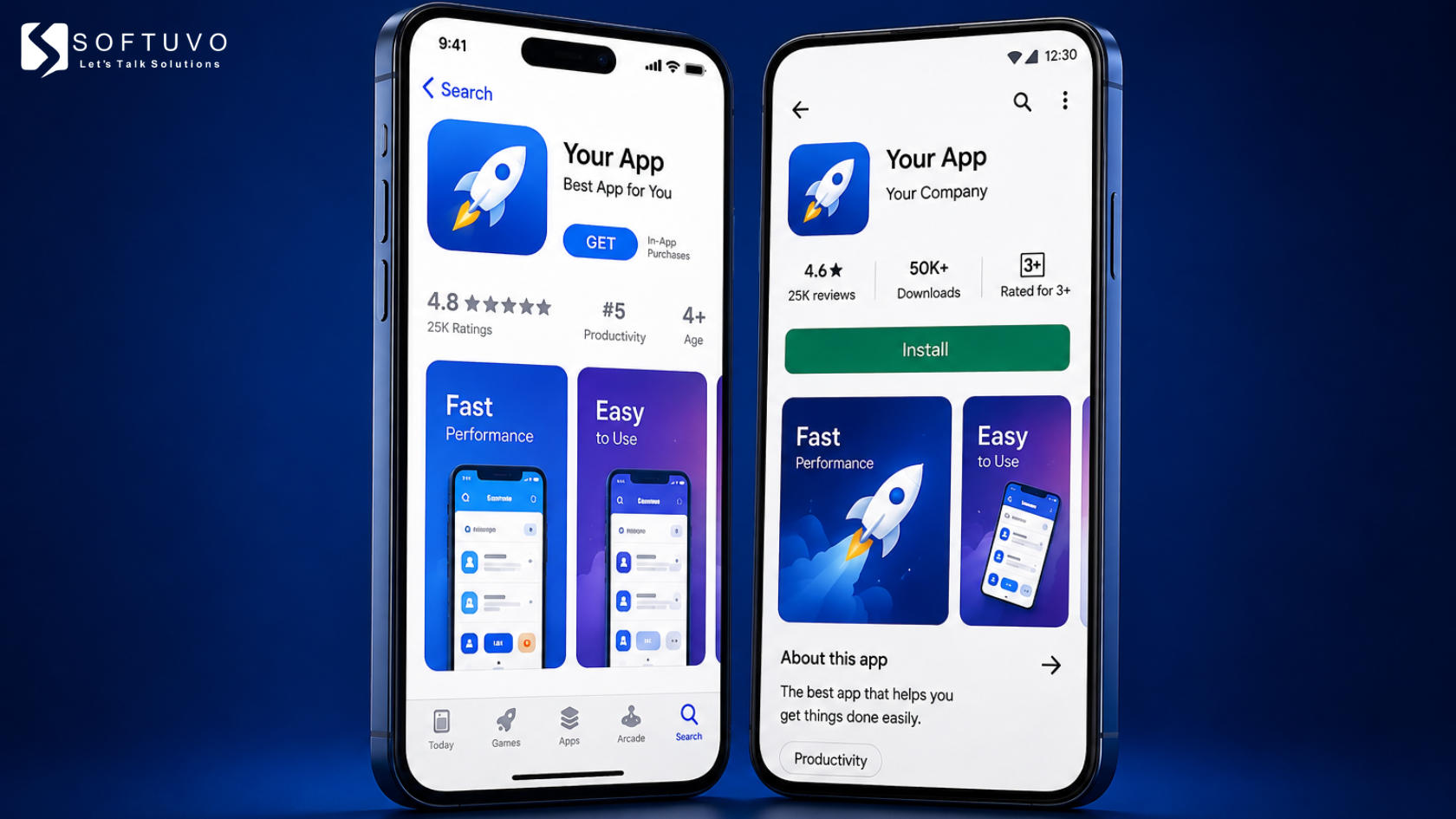
How to Optimize Your App Store Listing for Maximum Visibility and Conversions

With millions of apps competing for attention across the App Store and Google Play, discoverability has become one of the biggest growth challenges for product teams.

This is where App Store Optimization Services play a defining role.

App Store Optimization (ASO) is not just about keywords or visuals. It’s about aligning your product story, technical performance, and user intent in a way that both algorithms and humans respond to. When done right, ASO becomes the foundation for sustainable growth, helping brands increase app visibility, improve user trust, and drive long-term organic installs.

In this guide, we’ll break down how to optimize your app store listing for maximum visibility and conversions, using proven, practical techniques that go far beyond surface-level tweaks.

Why App Store Optimization Matters More Now

Over 70% of mobile users discover new apps through search within app stores. Yet, most app listings are built once and forgotten, leaving massive growth potential untapped.

Effective ASO helps you:

  • Get discovered by high-intent users

  • Convert visitors into downloads

  • Reduce dependency on paid acquisition

  • Improve retention through aligned user expectations

When ASO is a part of your broader mobile app marketing strategies, it becomes a powerful engine for predictable, scalable growth.

Step 1: Understand User Intent Before You Optimize

Before changing anything in your listing, the first question should be:

Why would a user search for an app like mine?

User intent drives everything in ASO, from keyword selection to visual design. There are three primary intent types:

  1. Problem-solving intent: Users searching for a solution (“expense tracker,” “habit builder”)

  2. Brand-driven intent: Users are already aware of your brand

  3. Feature-driven intent: Users looking for specific functionality (“AI photo editor,” “offline maps”)

Your optimization strategy must reflect which of these matters most for your product.

Step 2: Master Keyword Research for App Stores

Unlike SEO, ASO keyword research is constrained by limited metadata space and evolving ranking algorithms.

Effective app store optimization techniques start with identifying keywords that balance:

  • Search volume

  • Competition level

  • Relevance to your product

  • Commercial intent

Where to Use Keywords Strategically

For iOS:

  • App name & subtitle

  • Keyword field

  • In-app purchases (IAPs)

For Android:

  • App title

  • Short description

  • Long description

But keyword placement alone is not enough.

You must structure content in a way that feels natural to users while remaining readable. Overstuffing keywords leads to a poor user experience and lower conversion, negating any visibility gains.

Step 3: Optimize for Visibility Without Sacrificing Clarity

Increasing app visibility is not about ranking for every keyword, but it’s about ranking for the right ones.

Focus on:

  • Core keywords aligned with your app’s primary use case

  • Long-tail keywords that reflect specific user needs

  • Localization for region-specific discovery

For example, a fintech app might rank for:

  • “personal finance app” (high competition)

  • “budget app for freelancers” (high intent, lower competition)

This layered strategy helps you to grow discoverability organically while protecting your conversion rate.

Step 4: Design Visuals That Sell the Experience, Not Just the UI

Your app’s icon, screenshots, and preview videos are not decorative assets, as they are conversion tools.

A high-ranking app with poor visuals will struggle to convert, no matter how visible it is.

Best Practices for Visual Optimization

  • Show outcomes, not just screens

  • Use short, benefit-driven captions

  • Highlight differentiators clearly

  • Design for small screens first

  • Test variations regularly

This is where app store conversion rate optimization becomes critical.

Even a 1% improvement in conversion can lead to thousands of additional downloads monthly, even without increasing traffic.

At Softuvo, we A/B test visual assets the same way we test landing pages: with data, not opinion.

Step 5: Write Descriptions That Convert, Not Just Rank

Many teams treat app descriptions as keyword containers. In reality, they are sales copy.

Your description should:

  • Explain what problem your app solves

  • Who it is for

  • Why is it better than alternatives

  • What the user will gain

Structure matters:

  • Use short paragraphs

  • Add bullet points for features

  • Front-load benefits

  • Avoid jargon

  • Maintain scannability

A strong description builds trust, reduces friction, and supports both visibility and conversion goals.

Step 6: Use Ratings and Reviews Strategically

User feedback is one of the strongest conversion signals in app stores.

Apps with consistent ratings above 4.0 convert significantly better than those below.

But gathering reviews shouldn’t be random.

How to Build a Review Engine

  • Prompt users after successful actions

  • Avoid interrupting core flows

  • Respond to negative reviews publicly

  • Use feedback for product and listing improvements

A well-managed review strategy complements your ASO and strengthens your overall mobile app marketing strategies.

Step 7: Localize for Global Growth

If your app serves multiple regions, localization is not optional, but it’s a growth multiplier.

Localized ASO includes:

  • Translating keywords based on local search behavior

  • Adapting visuals to cultural context

  • Using region-specific benefits and use cases

Many apps leave growth on the table by using direct translations rather than market-aware localization strategies.

This is an opportunity to boost app downloads organically without increasing acquisition spend.

Step 8: Track, Measure, Improve—ASO is Never “Done”

ASO is not a one-time project. It’s a continuous optimization cycle.

Key metrics to track:

  • Keyword rankings

  • Conversion rates

  • Install velocity

  • Retention and uninstall rates

  • Review sentiment

Successful App Store Optimization Services are built on ongoing experimentation, learning, and refinement.

How Softuvo Approaches App Store Optimization Differently

Most agencies optimize listings. We optimize outcomes.

Our ASO framework combines:

  • Market research

  • Competitor intelligence

  • Data-driven experimentation

  • UX and CRO principles

  • Product-led growth thinking

Rather than focusing only on visibility, we align ASO with broader business goals: revenue, retention, and scalability.

This ensures ASO is not a silo but a core part of digital growth.

Common ASO Mistakes to Avoid

Even well-built apps fail due to basic ASO missteps:

  • Chasing volume over relevance

  • Ignoring conversion optimization

  • Using generic visuals

  • Not updating listings regularly

  • Overlooking reviews and ratings

  • Treating ASO as a one-time task

Avoiding these alone can unlock significant growth.

Final Thoughts

Optimizing your app store listing is not about tweaking text or changing screenshots—it’s about creating a discoverable, persuasive, and trustworthy product presence.

When done strategically, ASO becomes a long-term growth channel that:

  • Reduces customer acquisition costs

  • Improves product-market fit

  • Strengthens brand credibility

  • Scales sustainably

And in a world where paid marketing costs continue to rise, the ability to boost app downloads organically is no longer optional, but it’s essential.

If you’re serious about scaling your app, investing in the right App Store Optimization Services is one of the smartest growth decisions you can make.

Last updated: 1/22/2026

Read More

How Do Growing Businesses Decide Between SaaS and Custom Software?

As businesses grow, technology decisions become strategic investments. One of the most critical decisions that growing companies face is choosing between SaaS (Software as a Service) and custom software.

At an early stage, most businesses rely on off-the-shelf tools to move fast. But as operations scale, teams expand, and workflows become more complex, the question arises:

Should we continue using SaaS tools or invest in custom software built specifically for our business?

This decision impacts cost, scalability, security, productivity, and long-term competitiveness. In this article, we will discuss how growing businesses evaluate SaaS vs custom software, the trade-offs involved, and how to choose the best software for business growth based on long-term goals rather than short-term convenience.

Understanding SaaS and Custom Software

Before comparing options, it’s important to understand what each model represents.

What Is SaaS Software?

SaaS (Software as a Service) refers to pre-built, cloud-hosted applications delivered via subscription. These tools are designed to serve a broad range of businesses with similar needs.

Examples include CRM platforms, accounting tools, HR systems, and project management software.

SaaS tools are attractive because they:

  • Require no infrastructure setup

  • Offer quick onboarding

  • Have predictable monthly or annual costs

  • Are maintained and updated by the vendor

For early-stage and fast-moving teams, SaaS often feels like the fastest path forward.

What Is Custom Software?

Custom software is designed, developed, and deployed specifically for one business. It aligns directly with unique workflows, data structures, security requirements, and growth plans.

Custom solutions are typically built using custom software development practices and evolve alongside the business.

Unlike SaaS, custom software:

  • Is it related to your exact processes

  • Integrates deeply with existing systems

  • Scales without feature limitations

  • Becomes a long-term digital asset

At Softuvo, custom software is often positioned as a strategic foundation, not just a technical solution, helping businesses build systems that support growth rather than restrict it.

Why This Decision Matters for Growing Businesses

For startups and scaling companies, software is no longer just a support tool—it becomes part of the business model itself.

Choosing incorrectly can lead to:

  • Tool sprawl and rising subscription costs

  • Workflow inefficiencies

  • Data silos

  • Vendor lock-in

  • Limited scalability

Choosing wisely, however, enables:

  • Operational efficiency

  • Faster innovation

  • Better customer experiences

  • Stronger long-term ROI

This is why the debate around SaaS vs. custom software for startups and growing businesses is not about technology alone—it’s about strategy.

SaaS: Strengths and Limitations for Growing Businesses

Where SaaS Works Well

SaaS platforms are often the best software for business growth in early stages, especially when:

  • Processes are still evolving

  • Teams are small

  • Speed matters more than optimization

  • Budgets are limited

  • Standard workflows are sufficient

SaaS is especially effective for:

  • CRM and sales tracking

  • Email marketing

  • Basic accounting

  • Collaboration and task management

For many companies, SaaS is the right starting point.

Where SaaS Starts to Break Down

As businesses grow, SaaS limitations become more visible.

Common challenges include:

1. Limited Customization
Most SaaS tools allow configuration, not customization. When your workflows don’t fit predefined logic, teams start creating workarounds.

2. Scaling Costs
Per-user pricing increases as teams grow. Over time, cumulative subscription costs can exceed the cost of building a custom solution.

3. Integration Complexity
Multiple SaaS tools often lead to fragmented systems and manual data syncing.

4. Vendor Dependency
Roadmaps, pricing, features, and data policies are controlled by the vendor—not your business.

For companies planning long-term growth, these limitations often trigger the evaluation of custom software as a long-term software investment for businesses.

Custom Software: Strategic Advantages at Scale

Why Growing Businesses Move Toward Custom Software

Custom software becomes increasingly attractive when:

  • Business processes are unique

  • Data is a competitive asset

  • Automation opportunities are clear

  • SaaS tools no longer scale effectively

Unlike SaaS, custom software evolves with the business rather than forcing the business to adapt.

Key advantages include:

1. Alignment With Business Logic
Custom software reflects how your business actually operates—not how a generic platform assumes it should.

2. Scalability Without Penalties
Growth doesn’t automatically increase licensing costs.

3. Deeper Automation
Manual steps across departments can be eliminated through purpose-built workflows.

4. Competitive Differentiation
Custom systems often become a core competitive advantage, especially in product-driven or data-heavy businesses.

Softuvo’s digital transformation solutions focus on helping growing companies transition from fragmented tools to unified, scalable platforms.

SaaS vs Custom Software for Startups: A Stage-Based View

Rather than treating this as a binary choice, growing businesses benefit from a stage-based approach.

Early Stage: SaaS First

At this stage:

  • Speed matters more than optimization

  • Product-market fit is still evolving

  • Teams need flexibility

SaaS provides:

  • Fast deployment

  • Lower upfront costs

  • Minimal technical overhead

Growth Stage: Hybrid Approach

As complexity increases:

  • SaaS handles generic functions

  • Custom software supports core workflows

Many businesses integrate SaaS tools with custom-built systems to retain flexibility while gaining control.

Scale Stage: Custom as Core Infrastructure

At scale:

  • Operational efficiency becomes critical

  • Data integrity matters

  • Automation drives margins

Here, custom software becomes the backbone, while SaaS plays a supporting role.

This transition reflects a shift toward software solutions for growing businesses that prioritize long-term value over short-term convenience.

Cost vs Value: Rethinking Software Investment

A common misconception is that SaaS is “cheaper” and custom software is “expensive.”

In reality, the comparison should focus on value over time, not initial cost.

SaaS Cost Structure

  • Ongoing subscription fees

  • Per-user pricing

  • Add-ons and premium features

  • Increasing costs with scale

Custom Software Investment

  • Higher upfront development cost

  • Lower marginal cost over time

  • Full ownership of the asset

  • No licensing fees

For many businesses, custom software becomes a long-term software investment that delivers higher ROI within 2–3 years.

Security, Compliance, and Data Ownership

As businesses grow, security and compliance become non-negotiable.

SaaS platforms:

  • Apply generalized security standards

  • Share infrastructure across clients

  • Limit control over data residency

Custom software:

  • Aligns security policies with business requirements

  • Enables compliance-specific architecture

  • Offers full data ownership and governance

For regulated industries, custom solutions are often the only viable option.

The Role of AI and Automation in the Decision

Modern businesses are increasingly driven by AI and intelligent automation.

SaaS platforms often provide:

  • Generic AI features

  • Limited customization

  • Black-box decision logic

Custom software enables:

  • Tailored AI integration

  • Domain-specific automation

  • Predictive analytics aligned with business goals

Softuvo’s AI integration services help organizations embed intelligence directly into their systems rather than relying on one-size-fits-all tools.

Key Questions Growing Businesses Should Ask

Before deciding between SaaS and custom software, leadership teams should ask:

  1. Are our workflows becoming a source of inefficiency?

  2. Is software limiting innovation instead of enabling it

  3. Do recurring SaaS costs outweigh long-term value?

  4. Is data becoming a strategic asset?

  5. Do we need systems that scale without constraints?

If the answer to several of these is “yes,” it’s often time to explore custom software development.

Making the Right Choice:

The decision between SaaS and custom software is not about choosing what’s popular—it’s about choosing what aligns with where your business is going.

  • SaaS is ideal for speed and standardization

  • Custom software is ideal for scale, differentiation, and control

The most successful growing businesses evaluate both through the lens of long-term strategy, not short-term convenience.

FAQs: SaaS vs Custom Software for Growing Businesses

1. Is SaaS or custom software better for growing businesses?

There is no universal answer. SaaS works well for early-stage needs where speed and standard processes matter. Custom software becomes a better choice as businesses scale, workflows become complex, and software needs to align closely with business strategy and long-term growth.

2. When should a business move from SaaS to custom software?

Businesses typically consider custom software when SaaS tools start causing inefficiencies, recurring subscription costs rise significantly, integrations become complex, or when data and automation become strategic assets rather than operational support.

3. Is custom software only suitable for large enterprises?

No. Many startups and mid-sized companies invest in custom software once they reach a growth stage where differentiation, automation, and scalability are critical. Custom software is often a long-term investment for businesses planning sustained growth.

4. How does SaaS vs custom software impact long-term ROI?

SaaS has lower upfront costs but higher recurring expenses over time. Custom software requires an initial investment but often delivers better ROI in the long run by reducing licensing fees, improving efficiency, and supporting scalable operations without usage-based cost increases.

5. How does AI influence the SaaS vs custom software decision?

AI capabilities in SaaS platforms are often generic. Custom software allows businesses to integrate AI in ways that align with their data, workflows, and objectives, making AI-driven automation and insights more impactful and relevant.

6. What should businesses evaluate before choosing software solutions?

Key considerations include operational complexity, growth plans, total cost of ownership, data security requirements, integration needs, and whether software will enable or limit innovation over the next 3–5 years.

Final Thoughts

Software decisions shape how businesses operate, innovate, and compete.

Choosing the right software solution for business growth means understanding:

  • Your current stage

  • Your operational complexity

  • Your long-term vision

At Softuvo, businesses are guided through this decision with a focus on clarity, scalability, and measurable outcomes, helping teams build systems that support growth rather than restrict it.

If your organization is evaluating SaaS vs custom software for startups or growing enterprises, Softuvo can help assess your needs and design the right technology roadmap.


Last updated: 1/12/2026

Read More

Why Businesses Need Intelligent Automation to Stay Competitive in 2026

Introduction

As global markets move toward 2026, business leaders are facing a defining moment. Competitive advantage is no longer driven by scale, pricing, or geographic reach. It is driven by speed, intelligence, and adaptability. CEOs are under pressure to deliver growth by controlling costs, and CTOs are expected to modernize technology stacks without disrupting operations.

Across industries, traditional operating models are reaching their limits. Manual workflows, siloed systems, and slow decision cycles are no longer sustainable in a world of AI, data, and constant change. This is why intelligent automation has emerged as a strategic priority at the boardroom level.

In this article, we explore why AI automation and business process automation are becoming essential for executive leaders and how intelligent automation enables long-term resilience for businesses. You’ll also know why organizations that delay adoption risk falling behind by 2026.

What Is Intelligent Automation?

Intelligent automation refers to the combination of artificial intelligence (AI), machine learning (ML), advanced analytics, and business process automation (BPA) to automate end-to-end workflows that require judgment, adaptation, and decision-making.

Intelligent automation systems can:

  • Learn from historical and real-time data

  • Adapt to changing business conditions

  • Make context-aware decisions

  • Continuously improve performance over time

At a leadership level, this translates into clearer operational visibility, faster strategic decision-making, and technology foundations that evolve with the business.

Understanding the Difference - Intelligent Automation vs Traditional Business Process Automation

Traditional business process automation (BPA) focuses on automating repetitive, rule-based tasks such as routing purchase orders or syncing data between systems. These workflows follow predefined rules and work well in stable environments. However, when exceptions arise or data formats change, human intervention is often required.

Key characteristics of traditional BPA:

  • Automates routine, rule-driven tasks

  • Requires manual handling for exceptions

  • Limited ability to adapt to change

  • Widely adopted, with around 70% of organizations using structured automation by 2025

Intelligent automation extends BPA by embedding artificial intelligence and machine learning into automated workflows. These systems can interpret unstructured data, learn from patterns, and make context-aware decisions.

What sets intelligent automation apart:

  • Uses AI to analyze and learn from data

  • Handles exceptions without manual intervention

  • Adapts workflows dynamically as conditions change

  • Expected to be adopted by nearly 80% of companies by 2025

The difference becomes clear in real-world scenarios:

  • Traditional BPA extracts invoice data and routes it based on fixed rules.

  • Intelligent automation interprets multiple document formats, detects anomalies, and adjusts workflows automatically as it learns from new data.

The business impact is measurable:

  • Up to 42% reduction in process cycle time

  • Approximately 35% lower operating costs compared to manual or rule-based approaches

  • Better scalability as business complexity increases

In essence:

  • Traditional BPA improves efficiency through fixed rules.

  • Automation adds learning, adaptability, and data-driven judgment.

This shift transforms automation from an operational tool into a strategic capability, enabling organizations to scale, adapt, and stay competitive in 2026 and beyond.

Why Intelligent Automation Is a Strategic Priority in 2026

1. Complexity Has Become the New Normal

Modern enterprises operate across:

  • Global supply chains

  • Hybrid and remote workforces

  • Multi-cloud and SaaS environments

  • Regulatory and compliance frameworks

Managing this complexity manually introduces inefficiencies, risk, and delays. AI automation for businesses creates a unified operational layer that connects systems, data, and decision-making in real-time.

2. Speed and Responsiveness Define Market Leaders

In 2026, market leaders will be defined by how quickly they can:

  • Respond to customer demand

  • Adjust pricing or supply strategies

  • Launch new digital products

Organizations that implement AI automation can reduce process cycle times by up to 50–60%, enabling faster execution without sacrificing quality.

3. Executive Focus Is Shifting from Cost to Value

Historically, automation initiatives focused on cost reduction. Today, leaders are prioritizing value creation, including:

  • Better customer experiences

  • Data-driven growth strategies

  • Faster innovation cycles

Intelligent automation supports this shift by enabling predictive insights, personalized engagement, and scalable innovation across the enterprise.

Benefits of Intelligent Automation for Business Growth

1. Sustainable Cost Optimization

This intelligent automation reduces the operational costs while maintaining quality and compliance. Key impacts include:

  • Lower dependency on manual labor

  • Reduced error rates and rework

  • Improved audit and compliance readiness

Unlike one-time cost cuts, these efficiencies compound over time.

2. Data-Driven Decision-Making at the Executive Level

AI-powered automation systems analyze structured and unstructured data to deliver insights that support:

  • Strategic planning

  • Demand forecasting

  • Risk mitigation

  • Investment prioritization

This enables leadership teams to move from intuition-based decisions to evidence-based strategies.

3. Elevated Customer Experience Across Touchpoints

Global customers expect consistency, speed, and personalization regardless of region or time zone. Intelligent automation enables:

  • 24/7 intelligent customer support

  • Personalized product and service recommendations

  • Faster issue resolution and reduced churn

Customer experience becomes a competitive differentiator, not a cost center.

4. Scalability Without Organizational Strain

Traditional growth models increase complexity as organizations scale. Intelligent automation breaks this pattern by allowing businesses to:

  • Expand operations without proportional headcount growth

  • Standardize processes globally

  • Maintain governance and control

This is particularly valuable for enterprises and fast-scaling global companies.

Industry-Specific Use Cases of Intelligent Automation

Financial Services

  • AI-driven fraud detection

  • Automated compliance monitoring

  • Real-time financial reporting

Healthcare and Life Sciences

  • Intelligent patient data management

  • AI-assisted diagnostics

  • Automated appointment and resource scheduling

Retail and E-commerce

  • Predictive demand forecasting

  • Dynamic pricing optimization

  • Personalized omnichannel experiences

Manufacturing and Supply Chain

  • Predictive maintenance

  • Inventory and logistics optimization

  • Quality control using computer vision

These examples highlight how business process automation enhanced with AI delivers measurable, strategic outcomes.

Common Executive Concerns and How to Address Them

Concern 1: Organizational Resistance to Change

Solution:

  • Position intelligent automation as augmentation, not replacement

  • Start with pilot programs

  • Communicate value through measurable KPIs

Concern 2: Data Quality and Governance

Solution:

  • Invest in data standardization

  • Implement governance frameworks

  • Use AI models that improve accuracy over time

Concern 3: Legacy System Integration

Solution:

  • Adopt API-first automation platforms

  • Use modular and scalable architectures

  • Modernize incrementally rather than all at once

The Strategic Outlook Beyond 2026

As AI capabilities mature, intelligent automation will evolve from task optimization to autonomous decision-making systems. Organizations that invest early will gain:

  • Greater resilience to market volatility

  • Faster innovation cycles

  • Stronger global competitiveness

Those who delay risk operational inefficiencies and strategic stagnation

FAQs

1. Is intelligent automation suitable for large enterprises only?

No. Intelligent automation can be adopted incrementally and scaled across organizations of all sizes.

2. How does AI automation differ from traditional RPA?

RPA follows predefined rules, while AI automation learns, adapts, and makes decisions based on data patterns.

3. What is the typical ROI timeline?

Many organizations measure ROI within 6 to 12 months, depending on scope and implementation maturity.

4. How secure is intelligent automation?

When implemented with proper security controls, compliance frameworks, and monitoring, intelligent automation enhances overall system security.

Conclusion

By 2026, competitiveness will be defined by how intelligently organizations operate, not by how hard they work. Intelligent automation enables leaders to align technology with strategy, unlock sustainable growth, and future-proof their enterprises.

By combining AI automation with business process automation, businesses can move from reactive operations to proactive, insight-driven leadership.

Ready to Lead with Intelligent Automation?

As organizations plan for long-term growth, intelligent automation should be approached as a strategic transformation, not a one-time technology initiative. Success depends on identifying high-impact processes, designing scalable architectures, and aligning automation with business goals.

At Softuvo, intelligent automation initiatives are built with this long-term perspective in mind. By combining AI-driven technologies with deep experience in process automation and digital engineering, Softuvo helps organizations design secure, scalable, and adaptable automation solutions that evolve with changing business needs.

Last updated: 1/15/2026

Read More

Incident Response Management for Email Compliance: Essential Steps

In the age of digital communication, email remains a primary tool for business operations. However, with the increasing frequency of cyber threats and stringent regulatory requirements, managing incident response for email compliance has become more critical than ever. 

Ensuring your organization is prepared to handle email-related incidents can protect sensitive information, maintain customer trust, and comply with legal obligations. Here are the essential steps to effective incident response management for email compliance.


Understanding Email Compliance

Email compliance involves adhering to various laws and regulations that govern the use and security of email communications. These regulations can vary depending on the industry and geographic location but commonly include standards such as GDPR, HIPAA, and CCPA. 

Non-compliance can result in severe penalties, legal consequences, and damage to an organization’s reputation. 

Key Regulations to Consider

  1. General Data Protection Regulation (GDPR): Governs data protection and privacy in the European Union.

  2. Health Insurance Portability and Accountability Act (HIPAA): Protects sensitive patient information in the healthcare sector.

  3. California Consumer Privacy Act (CCPA): Enhances privacy rights and consumer protection for residents of California.

Steps to Effective Incident Response Management

1. Develop a Comprehensive Incident Response Plan

A well-documented incident response plan (IRP) is the foundation of effective incident management. This plan should outline the procedures for detecting, responding to, and recovering from email security incidents. Key components of an IRP include:

  • Incident Detection: Implement systems to monitor and detect suspicious email activities.

  • Incident Classification: Categorize incidents based on their severity and potential impact.

  • Response Procedures: Define clear steps for responding to different types of incidents.

  • Communication Plan: Establish communication protocols for notifying stakeholders and regulatory bodies.

  • Recovery Procedures: Outline steps to restore normal operations and prevent future incidents.

2. Implement Robust Email Security Measures


Proactive email security measures can significantly reduce the risk of incidents. These measures should include:

  • Spam Filters: Use advanced spam filters to block malicious emails.

  • Encryption: Encrypt sensitive email communications to protect data in transit.

  • Multi-Factor Authentication (MFA): Require MFA for accessing email accounts.

  • Employee Training: Conduct regular training sessions to educate employees about phishing attacks and safe email practices.

  • Anti-Virus Software: Ensure that all email systems are protected with up-to-date best antivirus software. These tools can provide an additional layer of security to safeguard your email communications.

3. Monitor and Detect Incidents

Continuous monitoring of email systems is essential for early detection of incidents. Utilize tools and technologies that can identify unusual patterns or behaviors in email traffic. Automated alert systems can notify your security team of potential threats, enabling a swift response.

4. Conduct a Thorough Investigation


When an email security incident occurs, it’s crucial to conduct a thorough investigation to understand the scope and impact. Key steps in the investigation process include:

  • Identify the Source: Determine how the incident occurred and identify the source of the breach.

  • Assess the Impact: Evaluate the extent of the damage, including data loss, system compromise, and potential regulatory violations.

  • Collect Evidence: Gather and preserve evidence for further analysis and potential legal proceedings.

  • Document Findings: Maintain detailed records of the investigation process and findings.

5. Respond Swiftly and Effectively

An effective response is critical to minimizing the impact of an email security incident. Your response should include:

  • Containment: Quickly contain the incident to prevent further damage. This may involve isolating affected systems or accounts.

  • Eradication: Remove the cause of the incident, such as deleting malicious emails or disabling compromised accounts.

  • Communication: Notify affected parties, including customers, employees, and regulatory bodies, as required by law.

  • Recovery: Restore normal operations and ensure that systems are secure before resuming business activities.

6. Review and Improve


After resolving an incident, conduct a post-incident review to identify lessons learned and areas for improvement. This review should include:

  • Incident Analysis: Analyze the incident to understand what went wrong and how it was handled.

  • Process Evaluation: Assess the effectiveness of your incident response plan and procedures.

  • Recommendations: Develop recommendations for improving your incident response capabilities.

  • Training and Awareness: Update your employee training programs based on the insights gained from the incident.

7. Maintain Compliance

Ensuring ongoing compliance with email regulations is an ongoing process. Regularly review and update your incident response plan to reflect changes in laws and regulations. Conduct periodic audits to verify compliance and address any identified gaps.

Conclusion


Incident response management for email compliance is a critical aspect of protecting your organization from cyber threats and ensuring adherence to regulatory requirements. 

By developing a comprehensive incident response plan, implementing robust security measures, monitoring email systems, and conducting thorough investigations, you can effectively manage email-related incidents and maintain compliance.

Remember, the key to successful incident response is preparation and continuous improvement. Regularly reviewing and updating your incident response strategies will help your organization stay ahead of emerging threats and regulatory changes.

Last updated: 1/9/2026

Read More

IoT Email benefits and security risks

The Intersection of IoT and Email Security

The integration of IoT devices into the business landscape has brought significant advancements in automation, efficiency, and data collection. That’s why more than 50% of organizations across the globe are currently using this technology, and 33% are planning to adopt it within the next two years.

However, the widespread use of IoT has also introduced new challenges, especially when it comes to email security. As IoT devices increasingly rely on emails for notifications, alerts, and updates, they can expand the system's attack surface, making it vulnerable to cyberattacks. This concern is particularly significant because 90% of cyberattacks are carried out through emails.

Therefore, understanding and addressing these vulnerabilities is critically important to minimize security risks your business may fall victim to. Not only will it allow you to prevent financial and data losses but it can also help you ensure regulatory compliance.

In this detailed guide, we’ll discuss potential email security vulnerabilities within IoT environments and outline best practices to mitigate them.

A.) Why Ensuring Email Security within IoT Environments is Important?

IoT stands for “Internet of Things” and it refers to a network of interconnected devices equipped with sensors and software to collect and exchange data. In a typical IoT environment, a wide range of devices communicate with each other and with a centralized system over the internet, which can be through emails.

When IoT devices are integrated into an organization's network, they gain access to and process sensitive data to perform critical business operations. Without proper email security measures, an IoT ecosystem becomes vulnerable to different types of cyberattacks.

Here are some key reasons why email security in IoT environments is critical:

  • Data Privacy: IoT devices connected to an organizational network collect sensitive business information and user data. If email communication between these devices and their associated systems is compromised, it can lead to unauthorized access to sensitive information, risking data privacy.

  • Device Control: Modern IoT devices can be controlled/managed remotely using email commands. If these emails are intercepted or manipulated, cybercriminals can gain unauthorized control over the IoT system to cause damage to your business.

  • Network Security: Usually, multiple IoT devices are connected to the same network infrastructure as other critical systems within an organization. Attackers can exploit compromised email communications from these devices as an entry point to infiltrate the network and launch further attacks.

  • Integrity of Operations: Emails can be used for sending important business updates, notifications, and alerts from IoT devices. If these communications are tampered with, it can lead to misinformation, disruption of operations, or failure to respond appropriately to critical events.

  • Compliance Requirements: Many industries have strict regulatory requirements regarding the security and privacy of data. Ensuring secure email communication over IoT devices can help you make sure that your organizations comply with these regulations, such as HIPAA and GDPR, and avoid legal consequences.

B.) Email Security Vulnerabilities in IoT Environments

Let’s discuss the specific vulnerabilities that can emerge when email communication intersects with IoT technology.

1. Insecure Configurations on IoT Devices

Many IoT devices come with default usernames and passwords, which are weak and easily guessable. For example:

  • Username = “admin”

  • Password = “1234” or “password”

If not changed, cybercriminals can easily exploit these credentials to gain unauthorized access to the system. It’ll allow them to access sensitive data from emails sent to/via an IoT device.

Poorly implemented email security features can also make IoT devices vulnerable to different types of security risks. For instance, insufficient validation of SSL certificates and improper handling of email headers can expose these devices to spoofing attacks.

Additionally, IoT devices, especially older models, can also be running on basic and unsecured communication protocols like SMTP, IMAP, and POP3. Without proper encryption, these protocols will make it easier for attackers to intercept and read email communications.

2. Weak Encryption Standards

If an IoT device carries out email communication in plaintext, sensitive information like business and user data can be intercepted by attackers through MITM (Man-in-the-Middle) attacks. That’s why it’s important to use encryption algorithms to turn plaintext into unreadable ciphertext. It ensures that even if the data is intercepted, it cannot be understood without the decryption key.

However, it’s also equally important to use advanced encryption protocols. That’s because modern-day computing power equipped with artificial intelligence and machine learning can easily break outdated/weak encryption protocols.

Important Note: Implementing encryption in an IoT environment is complex due to the large number of endpoints, which increases the attack surface. This complexity makes IoT emails particularly vulnerable to cyberattacks and it can result in unauthorized access to confidential business data.

3. Vulnerable Email Clients and Firmware

Email clients and firmware in IoT devices can introduce vulnerabilities if not properly secured. Many IoT devices come with lightweight email clients that lack robust security features, making them easy targets for cybercriminals. It allows them to execute malicious code for unauthorized access and/or manipulate email content for data compromise.

Similarly, outdated or poorly maintained firmware in IoT devices can create security gaps that attackers can also exploit. That’s why firmware updates are crucial for patching known vulnerabilities and strengthening the security posture of IoT devices.

4. Exploitation of IoT Device Features

Many IoT devices are designed to autonomously respond to triggers and commands they receive via email. While this functionality enhances convenience and efficiency, it can also introduce risks if not secured properly.

For instance, a smart security camera configured to send footage upon request via email can disclose sensitive information if accessed by unauthorized parties.

Additionally, IoT devices can also have remote access capabilities, which allow users to monitor and control them from different locations via the internet. This feature also offers convenience but can be exploited as well.

For example, a network-connected device with remote access functionality can be targeted by cybercriminals to disrupt business operations or steal sensitive data.

5. Weak Email Filtering

Most IoT devices typically don’t have robust malware and spam filtering capabilities and security controls to identify and block malicious emails effectively.

It makes it easier for cybercriminals to launch phishing emails or malware-laden messages directly to the device to hack them. It can lead to compromised devices and potential security breaches.

6. Social Engineering and Phishing Attacks

Social engineering and phishing attacks pose significant threats to email security in IoT environments. Malicious online actors use these tactics to manipulate individuals to reveal sensitive information or perform actions that compromise security.

For example, an attacker can use an IoT device as a proxy and start generating fake emails. They deceive recipients by crafting emails that appear to come from trusted sources, such as colleagues, service providers, or IoT device manufacturers.

Additionally, attackers utilize tactics like urgency or fear to make recipients take immediate action, like clicking on a link or opening an attachment. Once recipients interact with these malicious elements, they unknowingly reveal login credentials, and sensitive information, or enable malware to infect their devices.

As a result, the attackers gain unauthorized access to systems or compromise the security of IoT devices. It can lead to data breaches, operational disruptions, and financial losses for businesses.

7. IoT Email Delivery Challenges

While not exactly a security concern, the reliability of email delivery in IoT environments is still critical. That’s because it makes sure that important notifications and alerts from connected devices are received timely.

In an IoT ecosystem, multiple devices are connected and send emails as needed. However, not all emails are received due to connectivity issues, network congestion, server downtime, incorrect email configurations, or limitations in the device's email-handling capabilities.

Such issues can lead to missed notifications or alerts from connected devices, which results in reduced performance. Additionally, it can also prove to be costly for organizations whose entire operations rely on these devices.

C.) Best Practices to Ensure Email Security in an IoT Environment

Consider using the following best practices to ensure email security in IoT environments.


a.) Keep Everything Updated

Regular software and firmware updates are essential to ensuring email security in an IoT environment. These updates usually come with patches for security vulnerabilities that are discovered in the device's software.

Doing so will allow you to address known security flaws in your IoT devices and improve their defenses against potential cyber threats. Not only will it minimize the risk of unauthorized access to email communication but it’ll also enhance the overall security posture of your IoT ecosystem.

Additionally, software and firmware updates can also contain new security features and improvements to further improve the device's resilience to emerging threats.

b.) Use Strong Authentication Mechanisms

Strong authentication mechanisms are also important for ensuring email security in an IoT environment. It includes using unique and strong passwords for accessing IoT devices and associated email accounts.

Ideally, all passwords should consist of a combination of letters, numbers, and special characters to increase complexity and resist brute-force attacks.

Additionally, you should enable MFA (Multi-Factor Authentication) to add an extra layer of security. It’ll require all users to provide a second form of verification, such as a code sent to their mobile device, in addition to their password.

It’ll also help you prevent unauthorized access to email communications and significantly reduce the risk of security breaches.

c.) Utilize the Power of Network Segmentation

Network segmentation refers to the practice of isolating IoT devices on separate networks to limit their exposure to potential security threats. By segregating IoT devices from other critical systems and applications, you can contain any security breaches that might occur within the IoT environment.

It’s one of the best ways to prevent unauthorized access to sensitive business data transferred via email. Additionally, network segmentation also allows for more granular control over traffic flows. It enables you to enforce stricter security policies tailored to the specific requirements of your IoT environment.

d.) Implement Encryption

Encrypting your IoT email communications allows you to maintain the confidentiality and integrity of the data being transmitted. It’s important to use modern encryption protocols such as SSL, TLS, and STARTTLS.

These protocols are hard to break and they encrypt email data to make it unreadable to anyone intercepting the communication.

In addition to encrypting email traffic, using VPNs (Virtual Private Networks) with IoT devices can further enhance security. VPNs create a secure, encrypted connection between IoT devices and email servers, regardless of the network they are connected to.

They also mitigate the risk of interception and unauthorized access to email communications. Make sure that you opt for a reliable VPN service, such as NordVPN and Surfshark VPN, to keep your email communications secure and confidential.

e.) Use Robust Email Authentication Standards

Modern email authentication standards, such as DMARC, SPF, and DKIM are designed to enhance email security. DMARC allows you to specify policies for handling emails that fail authentication checks. It provides insight into email traffic to protect against phishing and spoofing attempts.

Whereas SPF allows you to specify which IP addresses are authorized to send emails on behalf of their domain, which prevents unauthorized senders from spoofing legitimate domains.

DKIM is used to add a layer of security, as it allows senders to digitally sign emails with cryptographic signatures. It can be verified by recipients to ensure the integrity and authenticity of the message.

For expert guidance and consultation on email compliance, consider reaching out to weDMARC, where you can access valuable insights and assistance from industry professionals.

f.) Educate Your Staff

One of the most effective ways to secure your email communication in an IoT environment is to educate your staff about the latest security threats. You can conduct workshops and training programs to help your teams recognize potential security risks, adopt secure email practices, and respond to cyber threats the right way.

Training sessions can cover different topics like identifying phishing emails, avoiding suspicious email attachments or links, creating strong and unique passwords, and understanding the importance of email encryption and authentication.

This way you can keep your staff vigilant against evolving cyber threats and minimize the risk of email-related security incidents.

g.) Utilize the Services of a Trusted IoT Solution Provider

If you're looking for IoT development services, make sure that you opt for the expertise of a reliable provider. A trusted IoT development partner will bring invaluable experience and proficiency in creating secure solutions designed specifically for your business’s needs.

When selecting an IoT development provider, prioritize these factors:

  • Proven track record of delivering secure and reliable IoT solutions

  • Compliance with security standards and protocols

  • Robust testing and validation processes

  • Commitment to ongoing support and maintenance

A reliable and experienced partner will ensure that your IoT infrastructure remains secure, resilient, and aligned with your business objectives.

D.) Final Words

Securing email communication within IoT environments is critical for protecting sensitive business data and mitigating cybersecurity risks. We hope this guide has helped you understand the security vulnerabilities that can arise in IoT email communication and the best practices to address them effectively.

Lastly, if you’re planning to develop an IoT system with email capability, make sure that you partner up with a reliable and trustworthy service provider. It’ll ensure that your project is in capable hands, with experts who understand the importance of IoT-enables email security to protect your data.

Also, for comprehensive email compliance solutions and tools, consider leveraging YourDMARC's SaaS platform, providing access to a suite of tools and reports for email compliance management within your IoT infrastructure for enhanced protection and compliance. Consider exploring Software Outsourcing Journal's platform and directory as well. They provide objective reviews and all necessary information about top software outsourcing company, offering robust SaaS platforms designed to manage email compliance seamlessly within IoT infrastructures, enhancing both protection and regulatory adherence.


Last updated: 1/9/2026

Read More

5G Revolution: Insights by Softuvo


In this era of advanced technology, we have been seeing unusual transformations in the world of business. One such breakthrough has been the emergence of 5G Technology. Still, in its initial stage, this piece of innovation is set to revolutionize the way businesses operate. In line with this, we’ve sought to explore the profound impact of 5G Technology on businesses.

Accelerated Data Speeds

5G technology promises significant enhancements in data speed compared to its 4G predecessor. It will deliver higher multi-Gbps peak data speeds, ultra-low latency, more reliability, massive network capacity, increased availability, and improved user experience. What this means for businesses is that they would be able to execute tasks much more quickly and efficiently, hence, enhancing productivity exponentially.

Improved Connectivity

With a massive capacity to connect multiple devices at once, 5G will transform even the smallest pieces of equipment into vital data sources. This would mean that businesses may derive data from more diverse sources, leading to detailed insights, improved operations, and better decision-making for the enterprise. A fully interconnected workplace would not only improve collaboration but also free up resources and reduce the risk of error.

Transformation in Business Models

5G will be a powerful tool for businesses to deliver services in a completely different and innovative manner. It allows the creation of new business models with its capacity to deliver extreme real-time speed and responsiveness. Companies can transform conventional business models into cutting-edge digital versions with 5G, gaining a competitive advantage in the market.

New Opportunities for Growth

This impeccable technology will open an array of opportunities for businesses. It will enable the growth of new industries like autonomous cars, smart cities, connected machinery, and more. These innovations can bring about a whole new dimension of growth for businesses, driving them towards unprecedented market expansion.

Enhanced Mobile Workforce Capability

5G technology can provide seamless virtual cloud-based office capabilities that can increase the productivity of the mobile workforce. Employees will no longer be bound within the four walls of an office, enabling them to work seamlessly from anywhere, at any time.

In short, 5G is poised to be a game-changer across various business sectors, enabling features that were previously unthought-of. It is a potent catalyst for businesses to transform their growth trajectory and gain a significant competitive edge in the market.

At Softuvo, we believe in keeping pace with the rapidly changing technology landscape. As we integrate 5G into our services, we aim to bring not only an enhanced experience to our customers but also open new avenues of growth and efficiency for their businesses.


Last updated: 2/2/2024

Read More

Exploring Wearable Technology Benefits with Softuvo Solutions

Wearable technology is everywhere nowadays. From smartwatches to fitness trackers and even virtual reality headsets, these devices have permeated our everyday lives bringing forth an entirely new level of convenience and connectivity. And this trend is expected to continue, with Statista predicting that the number of connected wearable devices globally will surpass 1.1 billion by 2022. However, commonly utilized for consumer purposes, their true potential in areas such as healthcare, security, and productivity is yet to be fully harnessed. Indeed, the capabilities of wearable technology extend beyond merely counting steps or sending text messages.

1. Unlocking Health Insights

Wearable technology has already transformed healthcare in unprecedented ways. With these devices, doctors can remotely monitor patients' vital signs such as heart rate, blood pressure, and glucose levels, allowing for more personalized and efficient care. Furthermore, the real-time data generated by these devices offers incredible potential for medical research by providing insights into health behaviors and disease progression.

But this is only scratching the surface. Future developments in wearable technology could sound alerts for irregular heartbeats, detect falls in elderly patients, or even monitor brain activity in patients with neurological disorders. As newer, more advanced devices hit the market, the possibilities for healthcare applications seem infinite.

2. Revolutionizing Security

Wearable technology also brings promising possibilities for security and surveillance. Smart glasses could help law enforcement officers in identifying suspects, while tracking devices could ensure the safety of workers in hazardous conditions. Even more, some companies are currently exploring ways to use wearable tech for biometric authentication, providing a higher level of security than passwords or PINs ever could.

3. Powering Productivity

On the productivity front, wearable technology can do a lot more than just manage your calendar or notifications. For example, in the industrial sector, smart glasses provide hands-free access to crucial information, increasing efficiency and minimizing errors. Likewise, fitness trackers could contribute to workplace wellness programs, helping to boost employee morale and productivity.

As technology becomes increasingly ingrained in our lives, wearable devices have the potential to fundamentally change the ways we work, interact, and care for our health. With technological innovation advancing at a rapid pace, one thing is for certain: the future of wearable technology holds limitless potential, and we're only just starting to uncover it.

Here at Softuvo Website, we're dedicated to keeping you informed about the latest trends and developments in the software industry. Whether you're interested in wearable technology or any other aspect of the digital world, be sure to stay tuned for more in-depth pieces.

Last updated: 2/2/2024

Read More

SEO Mastery 2024: Guide by Softuvo

It's no secret that search engine optimization (SEO) is vital for any online business or website. As we ascend into 2024, effective SEO strategies have become even more crucial due to the ever-evolving algorithms of major search engines like Google, Yahoo, and Bing.

Whatever the size of your business, SEO can no longer be ignored. This comprehensive guide will help you understand and implement the necessary steps to optimize your website for search engines and significantly improve your online visibility.

Keyword Research

Keyword research forms the backbone of any successful SEO campaign. It involves finding the words and phrases that potential customers type into a search engine when looking for a product or service like yours. Once you have this information, you can optimize your content accordingly. Use tools like Google AdWords Keyword Planner, UberSuggest, or SEMRush to discover new keyword opportunities and analyze their search volume and competitiveness.

On-Page SEO

On-page SEO involves optimizing individual webpages for a specific keyword or phrase. This includes strategic placement of keywords in the title tag, meta description, headers, and the body of the content. It's also crucial to ensure that your website is mobile-friendly and has a fast loading speed. Google has made it clear it rewards sites that provide a good user experience, and these factors contribute significantly to that.

Link Building

Backlinks, also known as incoming or inbound links, play a major role in search engine ranking. When a high-quality site links to yours, search engines view it as a vote of confidence, which can boost your site's authority and ranking. Ways to acquire backlinks include guest blogging, creating compelling content that others want to link to, and reaching out to industry influencers.

Content Marketing

Great content is the heart of successful SEO. Whether it's blog articles, product descriptions, videos, infographics, or eBooks, high-quality content will attract visitors, increase dwell time, and improve your chances of getting backlinks. Remember to update your content regularly and ensure it's well-researched, engaging, and provides value to your audience.

Tracking and Analysis

Finally, no SEO campaign can succeed without proper tracking and analysis. Tools like Google Analytics or Search Console can provide valuable insights into your website's traffic, popular pages, user behavior, and more. This data will allow you to measure the effectiveness of your SEO strategies and make adjustments as needed.

In conclusion, as we move further into 2024, it's clear that SEO remains a critical aspect of any business success online. Implementing an effective SEO strategy can be challenging, but with the right approach and tools, you can significantly improve your website's visibility and reach your target audience more effectively. Remember, SEO is not a one-time effort but a continuous process that requires time, patience, and consistency.

Last updated: 1/31/2024

Read More

Innovative Software Solutions - Softuvo IT Services

In today's digital economy, data is the new oil. The continuous explosion of digital data from various sources such as social media, website visits, online transactions, and other technological streams has led to a need for comprehensive management and analysis of this massive information. This is where Big Data Analytics enters the scene.

Big Data Analytics refers to the complex process of examining large and varied data sets to uncover hidden patterns, unknown correlations, market trends, customer preferences and other insights that can help organizations make informed business decisions. The power of Big Data Analytics lies in its ability to transform raw data into meaningful information, providing a competitive edge and driving strategic business moves.

Revolutionizing Businesses through Big Data Analytics

Big Data Analytics empowers businesses to harness their data and use it to identify new opportunities, leading to smarter business moves, more efficient operations, higher profits and happier customers. Here is how Big Data Analytics is revolutionizing businesses:

1. Enhanced Customer Service:

By analyzing customer behavior and purchasing patterns, Big Data Analytics can predict future trends and customer expectations. This enables businesses to tailor their offerings to meet customer needs, thereby enhancing customer service and customer loyalty.

2. Streamlined Operations:

Big Data Analytics can help identify inefficiencies in business operations and suggest improvements. Firms can streamline their processes for higher productivity, lower costs and improved quality.

3. Risk Management:

Big Data Analytics aids in the prediction of potential risks and enables businesses to develop proactive strategies, thereby mitigating risk and avoiding pitfalls. This leads to greater stability and resilience in an ever-changing business environment.

4. Innovation and New product development:

Businesses can tap into the power of Big Data Analytics to identify new market trends and develop innovative products that can potentially set the market ablaze. Such harnessing of insights leads to creative innovation and a competitive advantage.

5. Better Decision Making:

Big Data Analytics offers deep insights that lead to better decision making. It paves the way for predictive and prescriptive analytics that aid in understanding the past, forecasting the future, and making data-driven decisions that drive business growth.

In short, Big Data Analytics is not just a passing fad; it's a revolution that is transforming businesses worldwide. It offers immense potential to harness valuable insights from mammoth data sets, thereby empowering firms to optimize performance, understand customer behavior better, and be more competitive.

At Softuvo Solutions, we specialize in leveraging the power of Big Data Analytics for your business transformation. We help you navigate through this complex domain and unlock the potential of data, thereby facilitating informed business decisions. Connect with us today for professional Big Data Analytics services and steer your business towards new horizons.

Last updated: 1/9/2026

Read More
Page 1 of 28 Next