
Generative AI Integration for Existing Business Systems
Softuvo embeds generative AI into the platforms your teams already use — so intelligence shows up inside workflows, not as another disconnected pilot.
Exploring how companies do this in practice? Read how companies integrate generative AI into existing systems.
What Is Generative AI Integration?
Generative AI integration means connecting large language models (and related AI services) to your data, APIs, and applications so they can summarize, draft, retrieve, recommend, or automate work inside real business processes.
It is not “buying a chatbot.” It is wiring AI into CRMs, ERPs, TMS/WMS, internal portals, support desks, and custom software — with access control, logging, and human review where risk requires it.
Softuvo approaches generative AI integration as application and workflow engineering: use-case selection, data readiness, API and model architecture, security, and rollout — not a one-off demo.
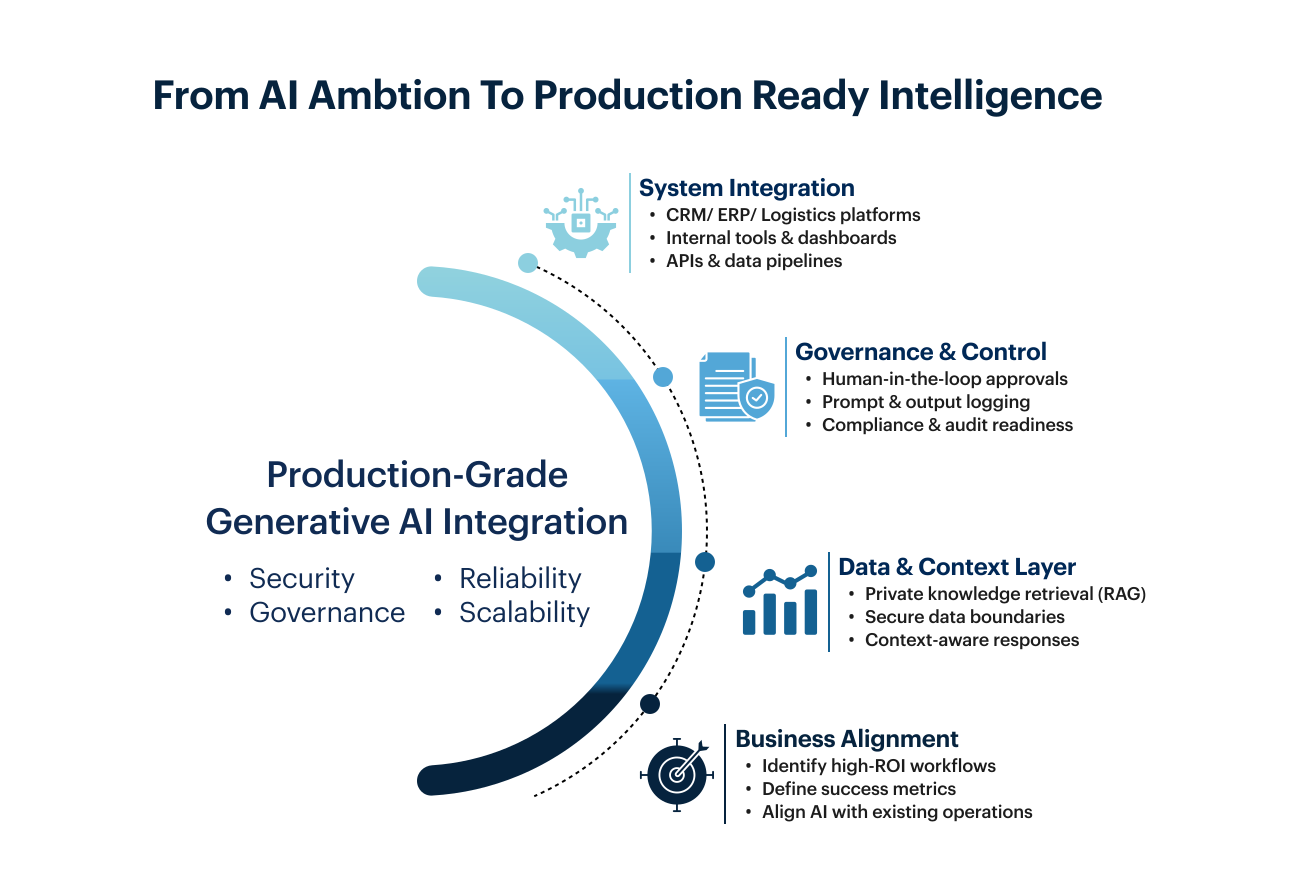
The Real Problems
that Gen AI Solves
Why most AI initiatives stall after pilots
Generative AI for business isn’t just a trend; it’s the next leap in digital transformation.
The result?
Disconnected pilots, unused copilots, and stalled momentum.
Legacy Platforms
Legacy platforms with fragile dependencies
Data Privacy
Sensitive data that cannot be exposed to public models
Trust & Safety
AI outputs that need oversight, guardrails, and validation
Strategic Gap
Teams unsure where AI actually adds measurable value
Softuvo’s role as a generative AI agency is to turn generative AI ambition into production-grade capability through practical AI development services.
Where Generative AI Integration Delivers Value
Common use cases, scoped to your stack and risk profile.
Operations & logistics
Exception summaries, dispatch notes, document extraction, and knowledge retrieval for planners.
Customer support
Ticket summarization, suggested replies, and knowledge-base assisted answers with escalation paths.
Sales & success
Lead and context briefs, personalized outreach drafts, and account research synthesis.
Internal knowledge
Secure Q&A over policies, SOPs, and product docs, often via retrieval-augmented generation (RAG).
Engineering & product
Assisted documentation, test-case drafting, and release-note generation inside your SDLC.
Banking & regulated ops
Assistive automation with audit trails and approval gates.
Intelligent automation in banking →How Softuvo Integrates Generative AI
A typical path from first conversation to production — one workflow at a time.
- 01
Discovery & use-case ranking
Map workflows where AI reduces delay or manual effort without unacceptable risk.
- 02
Data & access design
Define what the model may see; plan RAG, connectors, and retention.
- 03
Architecture
API-first model integration, guardrails, observability, and fallbacks.
- 04
Pilot in one workflow
Ship a narrow, measurable slice with human-in-the-loop where needed.
- 05
Hardening
Security review, prompt and evaluation loops, cost controls, and role-based access.
- 06
Scale
Expand to adjacent workflows; swap or upgrade models without re-platforming the core app.
For a deeper workflow angle, see how to use generative AI integration for workflow automation. For why chat alone is not enough, read beyond chatbots: generative AI integration.
Integrating Generative AI into Existing Workflows
Five workflow patterns that account for most of the generative AI integrations Softuvo ships. Each one plugs into a system you already run.
Document intake and extraction
Invoices, bills of lading, contracts, or claims arrive by email or portal. The model extracts fields, flags anomalies, and routes exceptions to a person; clean records flow into the ERP or TMS unchanged.
Ticket and request triage
Support and internal requests are classified, summarized, and matched to the right queue with a suggested reply. Agents approve or edit; nothing is sent without a person for high-impact cases.
Drafting reports and briefs
Weekly operations summaries, account briefs, and release notes are drafted from your systems of record, then reviewed. The source data stays where it is.
Knowledge retrieval inside tools
Retrieval-augmented answers over SOPs, policies, and product docs, surfaced inside the CRM, helpdesk, or intranet your team already uses.
Data enrichment and validation
Incoming leads, SKUs, or shipments are enriched and checked against business rules before they land in the pipeline.
What our generative AI integration services include
- AI readiness and use-case assessment: which workflows are worth integrating first, and what data they need
- Data connectors and retrieval (RAG) over your documents and systems, with access boundaries
- Model selection and routing: hosted or private models chosen for cost, latency, and data residency
- Evaluation sets, guardrails, and human-in-the-loop approval steps
- Observability, prompt and output logging, and cost controls
- Rollout, training, and iteration after the first workflow is live
Systems and patterns we integrate with
- Custom web and mobile apps Softuvo builds or modernizes
- CRM, ERP, helpdesk, CMS, and internal portals
- Cloud-hosted and hybrid environments
- Logistics and operations platforms, including fleet and routing products
- CI/CD and engineering tooling when AI assists delivery workflows
Model vendors, vector stores, and middleware are chosen per project — we do not force a single AI stack onto every engagement.
Security, privacy, and human-in-the-loop
- Least-privilege access to enterprise data
- Separation of public and private context (RAG boundaries)
- Logging of prompts and responses where compliance requires it
- Approval workflows for high-impact actions
- Clear ownership of AI-assisted decisions
How you can engage Softuvo
- Project delivery — Softuvo designs and ships an integration into your systems
- Staff augmentation — Softuvo specialists join your team for AI and app work
- Ongoing product partnership — iterate on use cases after the first pilot succeeds
Why teams choose Softuvo for
generative AI integration
- Custom software DNA — AI is embedded into real products and ops systems, not bolted on as a gimmick
- Experience across logistics and operations, modernization, and cloud workstreams that often need AI next
- Ability to staff specialists via hire developers or deliver as a project
- Security, governance, and human review designed in from the start
Frequently Asked Questions
What is generative AI integration?
It is connecting generative AI models to your applications and data so they assist real workflows — summarization, retrieval, drafting, recommendations — under your security and process controls.
How is generative AI integration different from a chatbot?
A chatbot is one interface. Integration embeds AI capabilities into the systems employees and customers already use, often without a separate chat product.
Beyond chatbots →Will Softuvo replace our CRM or ERP to add AI?
Usually no. Softuvo prefers integrating into stable systems unless replacement is already on your roadmap.
How companies integrate generative AI into existing systems →What about data privacy?
Access is scoped to what the use case requires. Softuvo designs boundaries, including RAG patterns, so private data is not treated as a free-for-all training dump. Specifics are confirmed in your statement of work.
How long does a first pilot take?
It depends on data readiness and risk. Softuvo typically starts with one high-impact, lower-risk workflow after discovery.
Can Softuvo help with workflow automation specifically?
Yes. Start with this service page and our guide on using generative AI for workflow automation.
Generative AI workflow automation guide →Can you integrate generative AI into our existing workflows without replacing our tools?
Yes. That is the default. Softuvo connects models to the CRM, ERP, helpdesk, or custom app you already run through APIs and connectors, so the workflow changes where it helps and stays the same everywhere else.
How are generative AI integration services priced?
Softuvo scopes a first workflow as a fixed-scope pilot after discovery, then prices expansion per workflow or as an ongoing partnership. Model and infrastructure costs are passed through transparently and capped with usage controls.
Scope a pilot with Softuvo →Do you only work with one model provider?
No. Softuvo selects models and infrastructure based on your latency, cost, residency, and capability needs.
How do we get started?
Share your target workflow, systems of record, and constraints. Softuvo will propose a scoped pilot path.
Contact Softuvo →
Ready to embed generative AI
where work already happens?
Tell Softuvo which systems and workflows matter most. We’ll propose a practical integration path — not another orphaned pilot.
Talk to Softuvo about generative AI integration