Generative AI Integration: What Businesses Should Know Before Getting Started
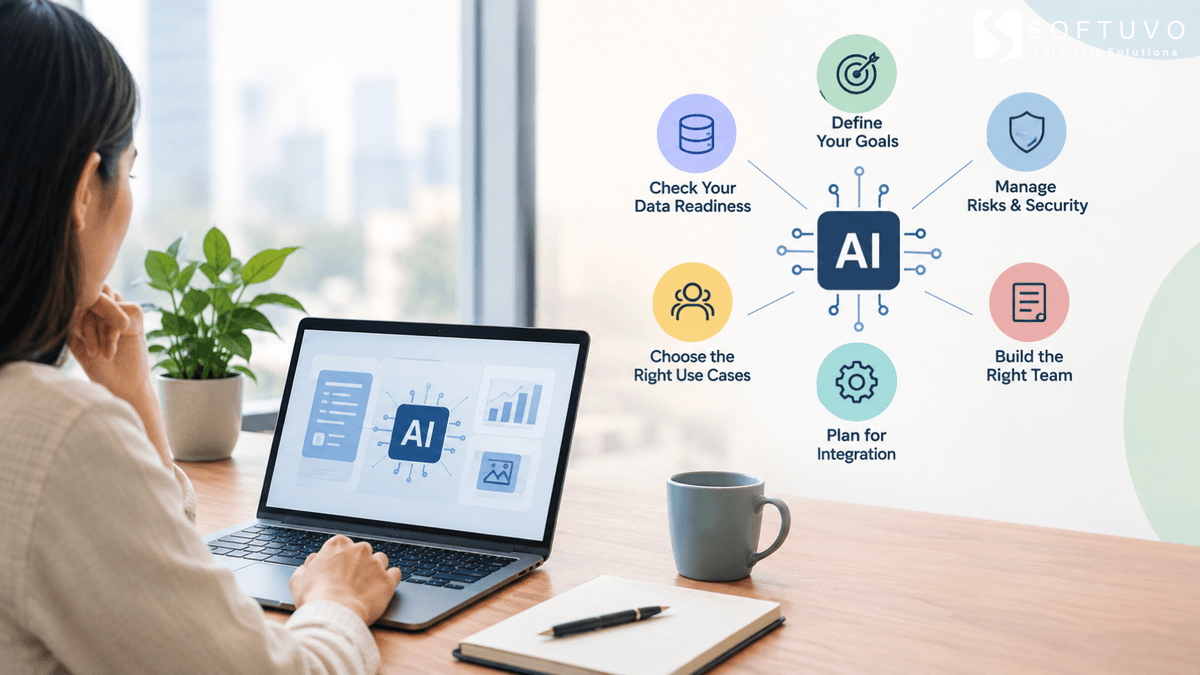
Deploying Generative AI for businesses has shifted from basic prompt wrappers to deep, event-driven system architecture. Most enterprise AI initiatives stall in the "proof-of-concept" phase, not due to model limitations, but because organizations treat LLMs like traditional software integrations.
Before committing capital to Generative AI integration, engineering and operational leaders must navigate four technical realities.
4 Technical Realities Simplified for Business Leaders
AI integration involves technical decisions that can directly affect cost, speed, reliability, and the quality of business outcomes. Here are four important concepts explained in practical business terms.
1. Vector Search vs. Standard Database Queries
Traditional databases are designed to find exact matches, but business knowledge is often stored in documents, emails, policies, and other unstructured content. AI systems need a better way to understand and retrieve this information.
Retrieval-Augmented Generation (RAG): Private company documents can be converted into searchable vector embeddings and stored in vector databases such as Pinecone or Qdrant. This allows an AI system to retrieve relevant information before generating an answer.
Contextual Chunking: Large documents are divided into meaningful sections so the AI can retrieve the right information without processing unnecessary content.
Why it matters to your business: Better information retrieval helps AI provide more relevant and accurate answers based on your company’s own data, rather than relying only on general model knowledge.
2. Context Window and Cost Optimization
AI models can process a limited amount of information in each request. Sending large amounts of unnecessary text can increase processing costs and response times.
Production-ready AI integrations use filtering and retrieval layers to send only the information that is relevant to each request.
Why it matters to your business: Keeping AI requests focused can help reduce API costs, improve response speed, and make AI applications more efficient as usage grows.
3. Model Routing and Multi-LLM Orchestration
Not every business task requires the same AI model. A simple task may work well with a faster, lower-cost model, while complex reasoning may require a more capable model.
AI integration architectures can use dynamic model routing to send different tasks to different models based on factors such as complexity, cost, speed, and accuracy requirements.
Why it matters to your business: Using the right model for each task can help balance performance and cost instead of paying for the most powerful model for every request.
4. Deterministic Guardrails
Generative AI is designed to produce flexible responses, but business processes often need predictable and controlled results. AI integrations can therefore use validation layers, structured schemas, and fallback logic to control how outputs are handled.
For example, tools such as Pydantic schemas or Guardrails AI can help validate structured responses before they reach another application or business workflow.
Why it matters to your business: Guardrails can reduce the risk of incorrect or unexpected AI output affecting production systems, helping make AI-powered workflows more reliable and easier to control.
Enterprise Use Cases & Impact Areas
High-Impact Integration Area | Architectural Mechanism | Business Impact |
Unstructured Document Ingestion | OCR + Multimodal RAG + ERP API Sync | Converts invoices, PDFs, and contracts into structured database entries instantly. |
Context-Aware CRM Automation | Real-Time Vector Indexing + Event Triggers | Synthesizes years of customer emails, tickets, and calls into actionable deal summaries before account reviews. |
Internal Codebase & Knowledge Search | AST Parsing + Hybrid Search (Keyword + Vector) | Reduces onboarding time for engineers and support staff by providing exact line/doc references instantly. |
Costs, Risks & Practical Considerations
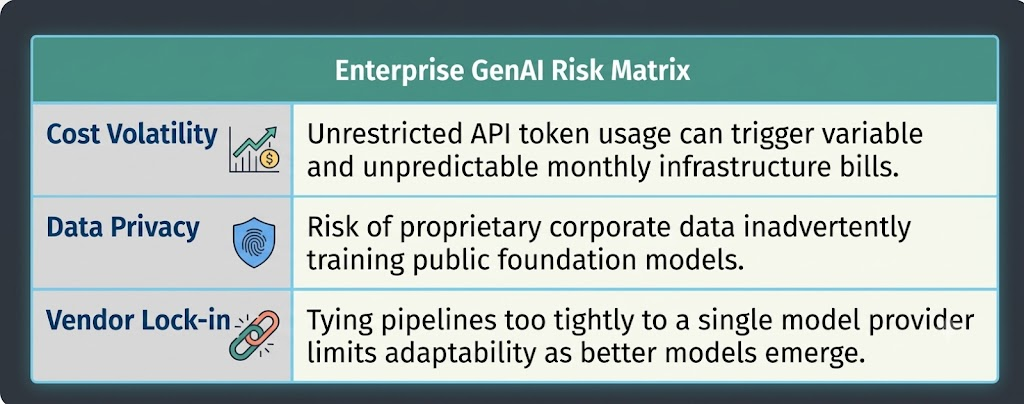
Total Cost of Ownership (TCO): Beyond model API pricing, budget allocations must cover vector database hosting, middleware development, observability tools, and ongoing prompt maintenance.
Data Protection Protocols: Enterprise deployments require private data boundaries to ensure proprietary information remains isolated from public training sets.
Vendor Agnosticism: Architectural middleware should stay modular so models can be swapped as performance and pricing dynamics change across the market.
A Step-by-Step Implementation Roadmap
Deploying enterprise GenAI effectively requires a disciplined phase-by-phase approach:
Discovery & Scoping (Weeks 1–2): Identify repetitive, document-heavy workflows with clear inputs and outputs. Establish success metrics around speed, accuracy, and cost savings.
Data Audit & Indexing (Weeks 3–4): Clean target documentation, set up vector databases, and establish data access controls.
Architecture & Middleware Design (Weeks 5–8): Build model routers, configure validation guardrails, and implement prompt management infrastructure.
Pilot Deployment & Evaluation (Weeks 9–12): Roll out the integration to a subset of internal users to evaluate accuracy, latency, and system cost under real-world conditions.
Production Scaling & Governance (Week 12+): Connect pipeline outputs directly into core software platforms, set token budget alerts, and monitor system performance over time.
Before You Start: Executive Readiness Checklist
Data Accessibility: Are key operational documents organized, updated, and stored in formats accessible via API?
Access Control Strategy: Are user permissions clearly defined so the AI respects existing data governance rules?
Performance Benchmarks: Have acceptable targets for response latency, output accuracy, and cost-per-query been established?
Fallback Protocols: Is there a human-in-the-loop escalation path when low-confidence model scores occur?
Infrastructure Ownership: Is an internal team or specialized engineering partner designated to maintain system prompts, database indexes, and API routing as models evolve?
Engineer Production-Grade AI Solutions with Softuvo
Integrating intelligence into legacy workflows, custom web platforms, and mobile ecosystems requires specialized middleware expertise.
Softuvo delivers full-stack digital transformation and custom Generative AI integration services. Rather than deploying off-the-shelf bots, Softuvo’s engineering team builds customized AI middleware, designs secure RAG pipelines, and handles multi-agent orchestrations tailored to complex tech stacks.
How Softuvo Secures Your AI Deployment:
Private Data Boundaries: Implementing enterprise-grade access controls so confidential company data is never used to train public foundation models.
Legacy System Interoperability: Building clean API adapters to connect AI orchestration layers directly into existing databases, custom CRMs, and enterprise tools.
Latency & Cost Optimization: Fine-tuning model pipelines, response caching, and prompt token usage to ensure predictable monthly API spend and sub-second user responses.
Stop Experimenting and Start Shipping Production-Ready AI.
Moving from an AI sandbox to a scalable enterprise tool requires proven engineering architecture. Softuvo designs high-performance Generative AI integration solutions built for real-world reliability, strict security, and measurable ROI.
Book an AI Architecture Consultation with Softuvo Today and build a scalable foundation for your business operations.