10 Reasons Why Enterprise Leaders Are Investing in AI Software Development in 2026
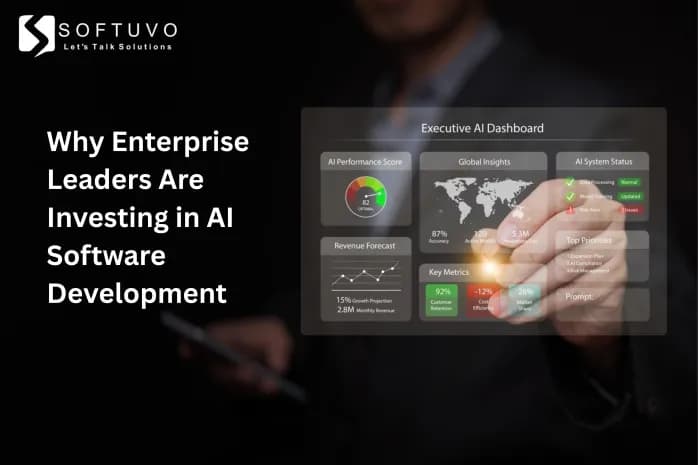
Two years ago, investing in AI software development was a smart move. Today, it's a survival decision.
In 2026, enterprise leaders aren't just talking about AI; they're writing cheques for it.
Global AI software spending crossed $300B in 2025 and is still accelerating.
McKinsey reports that 88% of companies have now embedded AI into at least one business function.
The shift has already happened. Here are the 10 reasons driving enterprise investment in AI right now.
1. AI Software Development Delivers Measurable ROI
The cost of building intelligent software has dropped. The ROI has become measurable. And the excuses have run out.
CFOs who once asked, "Where's the proof?" are now asking, "Why haven't we started yet?"
Enterprises are cutting operational costs by 30–50% in targeted workflows.
AI software development ROI typically pays back within 6–9 months of deployment.
2. AI-Assisted Software Development Accelerates Delivery
They changed how software gets built, not just how hard their teams work.
Agentic AI solutions autonomously plan, write, review, and iterate on software, compressing 6-month builds into weeks.
Engineering teams using AI-assisted pipelines ship 40% faster with fewer post-launch defects.
Gartner predicts 80% of enterprise software engineers will use AI coding assistants daily by 2027.
3. Early AI Adoption Creates Long-Term Competitive Advantage
In 2023, AI adoption was a differentiator. In 2026, it's a baseline.
Enterprises that invested in enterprise AI solutions two years ago have already compounded those gains: lower costs, faster teams, and sharper decisions. That's not a gap you close in a quarter.
Every quarter without movement is a quarter your competitors bank.
4. AI-Powered Personalization Drives Enterprise Growth
B2B and B2C customers expect personalized experiences in 2026. The enterprises delivering it at scale are winning disproportionate market share.
Generative AI for enterprises powers dynamic pricing, intelligent onboarding, and adaptive dashboards across millions of customers simultaneously.
5. Your Data Is Already Telling You Something. AI Helps You Hear It.
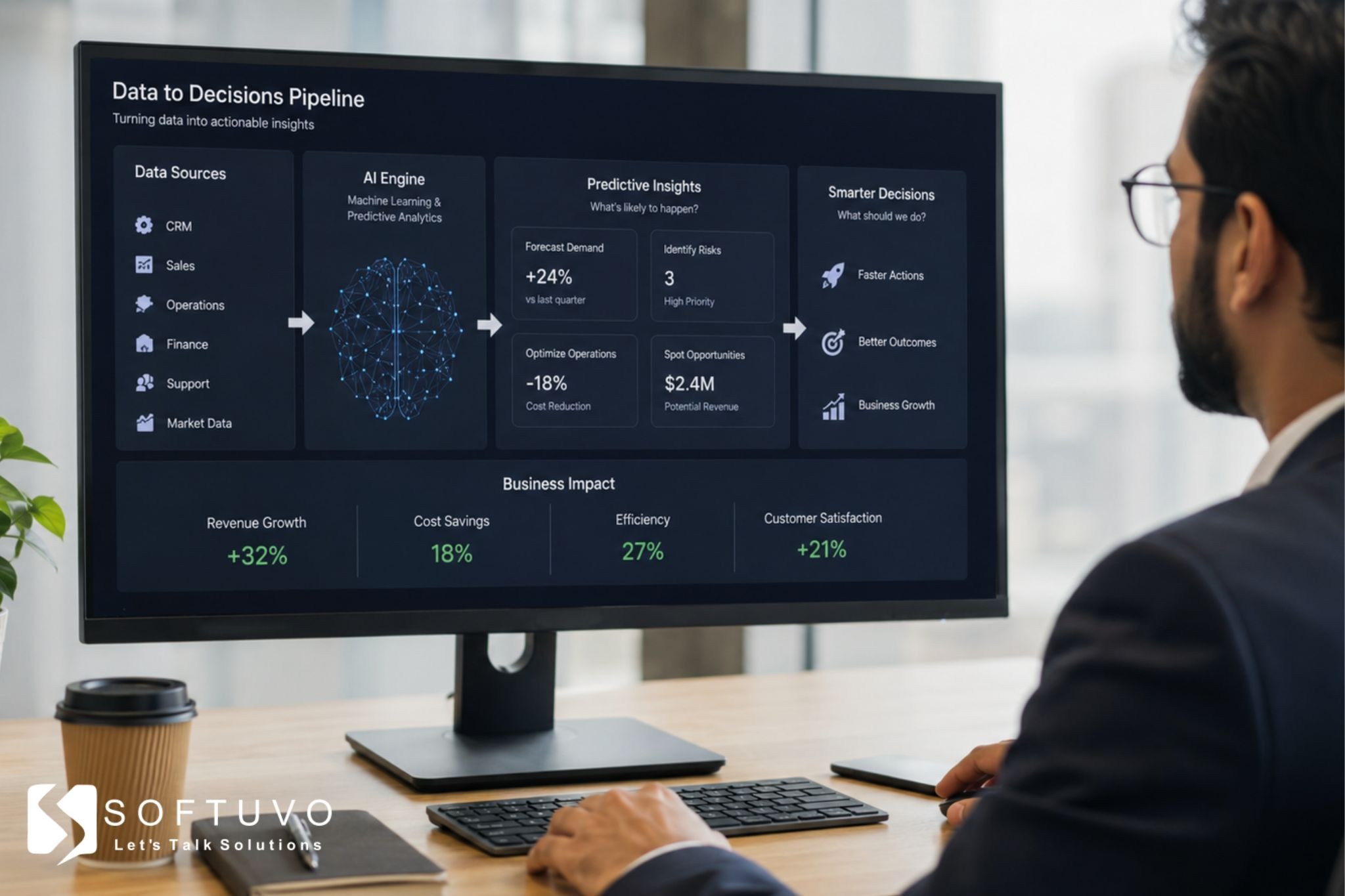
Most enterprises are still making decisions on reports that are days old by the time they reach the boardroom. AI changes the operating rhythm entirely.
Predictive analytics built into enterprise software development helps leaders forecast demand, flag risk early, and move before competitors do.
Exploring AI for your enterprise?
Softuvo builds custom AI platforms for logistics, healthcare, and finance. See what we've built.
6. The Workflows Eating Your Team's Time? AI Handles Them Now.
From HR onboarding to finance reconciliation to logistics dispatch, AI automation platforms manage full workflows end-to-end. No fatigue. No handoff errors. No 9-to-5 constraint.
Enterprises report a 60–70% reduction in process cycle time after AI automation.
Start with one high-volume workflow. The ROI it delivers makes the next investment easy to justify internally.
7. AI Strengthens Enterprise Cybersecurity
Phishing, supply chain attacks, identity fraud, the threat landscape is moving faster than human teams can track alone.
AI monitors thousands of signals simultaneously, flags anomalies in milliseconds, and responds before a breach escalates. Softuvo's own YourDMARC is built on exactly this principle.
8. You Can Scale the Business Without Scaling the Headcount
More customers. More data. More transactions, but not necessarily more people.
When software handles routing, summarisation, monitoring, and decision support autonomously, you grow revenue without growing costs at the same rate. AI software development breaks the traditional growth equation.
10x output. Not 10x salary costs.
9. Compliance Doesn't Have to Be a Quarterly Fire Drill
For regulated industries, healthcare, financial services, and cross-border operations, the compliance burden is growing. AI-embedded enterprise software development keeps enterprises continuously compliant, not just at audit time.
AI flags violations in real time and auto-generates audit trails, no manual chasing required.
AI compliance tools can reduce audit preparation time by up to 50%.
10. The Best Talent Follows the Best Technology
The engineers and product leaders shaping the next decade of your business have preferences about where they work, and those preferences favour AI-native environments.
Investing in generative AI for enterprises isn't just a product decision. It's a talent strategy.
Benefits of AI Software Development for Enterprises
Unified Intelligence: Turns siloed data into a connected intelligence layer across the entire organization.
Faster Execution: Shortens the gap between strategy and execution; decisions move from insight to action faster.
Fewer Costly Errors: Reduces human error in high-volume, high-stakes processes without removing human oversight.
Software That Evolves: Creates software that improves over time, unlike traditional systems that degrade without maintenance.
Bigger Output, Leaner Teams: Gives smaller enterprise teams the output capacity of a much larger organization.
Consistent Experiences at Scale: Delivers consistent customer and employee experiences across every touchpoint, at any scale.
Real-World Use Cases Across the Industry Applications
Logistics & Supply Chain: AI dispatch routing, forecasting delivery delays, and optimizing fleet utilisation in real time more accurately than a full operations team.
Healthcare patient intake, insurance verification, and compliance flagging run automatically, reducing administrative overhead by 45% and letting clinical staff focus on patients, not paperwork.
AI solutions for financial enterprises identify fraud in milliseconds and automatically create audit-ready compliance reports.
Retail & eCommerce: Generative AI for enterprises personalizes recommendations, automates inventory forecasting, and manages dynamic pricing in real time.
Education & eLearning: AI personalizes course content to the behaviour of each learner, identifying where each user is struggling and adapting delivery accordingly.
AI vs No AI: What Enterprise Leaders Are Seeing
Area | Without AI | With AI |
Development Speed | 6–12 month delivery cycles | Weeks with agentic AI pipelines |
Cost per Process | High manual overhead | 30–50% cost reduction |
Decision-Making | Historical reports | Real-time predictive insights |
Security | Reactive threat response | Proactive AI threat detection |
Compliance | Manual audit preparation | Automated, audit-ready workflows |
Scalability | Growth requires hiring | Scales without proportional headcount growth |
Final Thoughts
Enterprise leaders aren't investing in AI because it's trendy. They're doing it because the numbers are impossible to ignore: lower costs, faster outputs, smarter decisions, and a competitive edge that compounds over time.
The question for 2026 isn't "should we invest in AI?" It's "how fast can we move?"
The enterprises that will lead their industries in 2028 are making that decision today.
Whether you're starting from scratch or scaling an existing platform, the right AI software development partner makes that journey significantly shorter.
Ready to Build Your Enterprise AI Platform?
Softuvo helps businesses build smarter, from agentic systems to full-scale enterprise platforms.
FAQs
Q1. What is AI software development?
Building software that learns, adapts, and automates, using machine learning, NLP, or agentic AI, rather than just executing pre-written rules.
Q2. Why are enterprises investing in AI now?
The ROI is no longer theoretical. Mature tooling, measurable results, and competitive pressure have made 2026 the tipping point.
Q3. What are Agentic AI Solutions?
AI systems that plan, reason, and act autonomously across workflows, well beyond chatbots or basic automation. See Softuvo's agentic AI work.
Q4. How long does an enterprise AI platform take to build?
A focused MVP in 6–12 weeks. A full platform in 3–6 months, with value delivered in phases, not just at the end.
Q5. Which industries see the strongest AI ROI?
Logistics, healthcare, financial services, retail, and manufacturing, with high volume, high complexity, and significant manual overhead, make the gains substantial.
Generative AI integration
Put generative AI to work inside the systems you already run
Softuvo integrates LLMs and agents with your CRM, ERP and data, with evaluation, security and cost controls built in from the start.
Prefer email? Write to [email protected] or use the contact form.