Laravel vs Node.js in 2026: Which One Should Your Business Actually Use?

Every business reaches a point where someone asks, "Should we build this on Laravel or Node.js?"
It sounds like a technical question, but for a business owner or CTO, it's really about three things: how fast can we ship, how much will it cost to maintain, and will it scale when we grow?
This blog answers exactly that for businesses planning modern enterprise web development projects. No deep code comparisons. No benchmark charts. Just a clear, honest breakdown to help you make the right call for your project between Laravel vs Node.js. We'll examine both technologies as tools that address distinct problems in various enterprise scenarios.
“Businesses evaluating Laravel or Node.js for business applications often focus on scalability, speed, and maintenance costs.”
What Are We Actually Comparing?
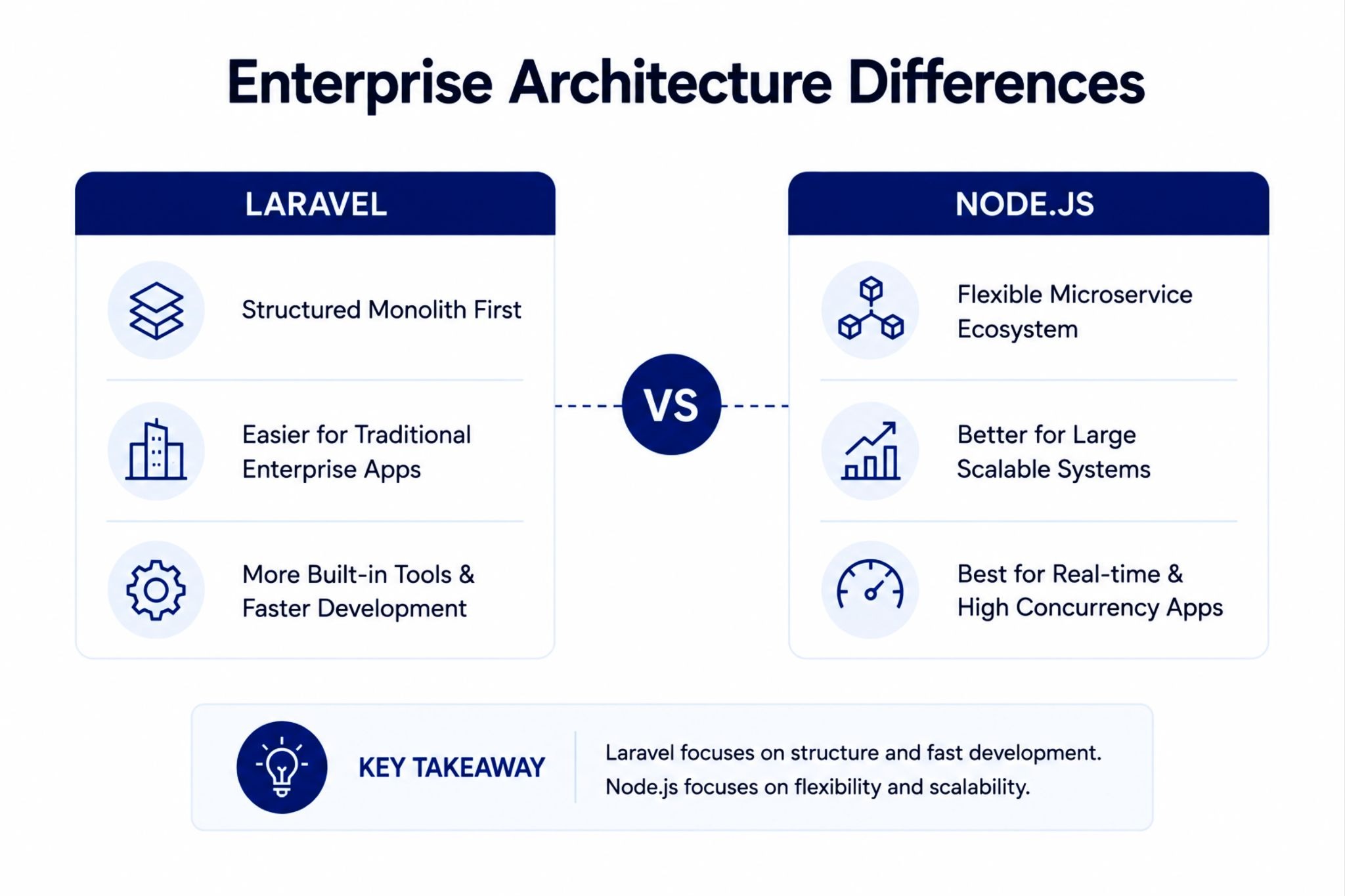
Laravel is a PHP framework. It comes loaded with built-in tools, user authentication, database management, background jobs, billing, email, and more. You start with a full toolkit and spend most of your time building your actual product.
Node.js is a JavaScript runtime. It's fast, lightweight, and incredibly good at handling things happening in real time, like live notifications, chat, or location tracking. However, unlike Laravel, it doesn't come with much built in. Your team assembles the stack from scratch.
Neither is better than the other in an absolute sense. They're built for different situations.
Where Laravel Wins for Enterprise
If your business is building something like a CRM, an admin portal, an ERP system, a SaaS platform, or an e-commerce solution, Laravel is very likely the right choice.
Here's why:
You ship faster
Laravel's built-in tools include authentication, role management, API endpoints, background queues, and billing. Your developers start building business features immediately instead of spending weeks wiring together third-party packages.
Real comparison: Building an equivalent SaaS foundation in Node.js typically requires integrating 8–12 separate packages before writing a single line of business logic. Laravel ships with all of that natively.
It's easier to maintain over time
Laravel enforces a consistent project structure. When a new developer joins your team, they can understand the codebase in hours, not days. For enterprise projects that run for 3–5 years with changing teams, this matters enormously.
Security is built in by default
Laravel automatically handles common vulnerabilities, SQL injection, cross-site scripting, and CSRF attacks out of the box. In industries such as finance, healthcare, or logistics, where compliance is non-negotiable, this approach significantly reduces risk.
The talent pool is large and cost-effective
Laravel developers are widely available, hiring is faster, especially across India, and senior talent is more accessible without the salary premium that specialist Node.js backend engineers often command.
Where Node.js Wins for Enterprise
Node.js can handle thousands of simultaneous connections without slowing down. This is because it processes requests through a single event loop rather than spinning up a new process for each one.
For most business applications, this makes no practical difference. But for specific use cases, it's a genuine game-changer.
Node.js is the right call when your product depends on:
Live tracking: delivery apps, fleet monitoring, logistics dashboards where location updates come in every few seconds from hundreds of drivers
Real-time messaging: customer support chat, team collaboration tools, or in-app notifications that need to push instantly
Live dashboards: operations rooms, financial trading interfaces, or monitoring panels that refresh in real time
High-concurrency APIs: when thousands of users are connected simultaneously and waiting for data
Example: You're building a delivery tracking app. Hundreds of drivers send location pings every 10 seconds. Thousands of customers are watching their order move on a map. That's exactly what Node.js was designed to handle. Laravel could do it, but you'd need significantly more infrastructure to manage those concurrent connections efficiently.
Node.js also makes sense when your entire team writes JavaScript. If your frontend is in React or Vue, using Node.js on the backend means one language across the whole stack, less context switching, easier code reviews, and simpler hiring.
Laravel vs Node.js: Which One Is Cheaper to Build and Maintain?
The part most blogs skip: Technology choice has a direct impact on your development cost and timeline. Here's what that looks like practically:
Laravel | Node.js | |
Time to first working product | Faster: built-in tools reduce setup time | Slower: stack assembly adds 2–4 weeks |
Developer availability | High, large PHP/Laravel talent pool | Moderate, good JS devs are common; backend specialists are less so |
Typical freelance rates | ₹1,500 – ₹8,000/hr ($20–120/hr) | ₹2,500 – ₹12,000/hr ($35–180/hr) |
Maintenance complexity | Lower: consistent structure | Higher: depends heavily on how the project was set up |
Best for | SaaS, portals, CRMs, e-commerce, ERPs | Real-time apps, live tracking, collaborative tools |
Still Unsure Which Stack Fits Your Product?
Choosing between Laravel and Node.js isn’t just a technical decision; Softuvo helps businesses choose the right technology architecture based on scalability, performance, development timelines, and long-term maintenance goals.
Four Questions to Help You Decide
Before you commit to either technology, run your project through these:
1. Does real-time functionality sit at the core of your product, or is it just a nice-to-have?
If it's core (live tracking, chat, instant updates), Node.js has a structural edge. If it's occasional, Laravel handles it fine with the right add-ons.
2. How fast do you need to go from idea to launched product?
If speed matters, and for most businesses it does, Laravel's built-in tools give you a meaningful head start.
3. What does your current development team know best?
Don't underestimate this one. A strong Laravel team will outperform a team learning Node.js on the job every single time.
4. Who's going to maintain the platforms two years from now?
If you're not sure, favor Laravel. Its conventions mean any competent PHP developer can pick it up without a long ramp-up.
What If You Need Both?
This is more common than people think. Many mature enterprise platforms use Laravel for the core application, the data layer, business logic, APIs, and reporting, and a lightweight Node.js service to handle the real-time layer (notifications, live feeds, WebSocket connections).
The two work well together, and it's an architecture we've designed and built for clients at Softuvo across logistics, retail, and fintech projects.
So, Which One Should You Actually Choose?
Having built enterprise software development projects across industries, our honest observation is this:
Most enterprise clients who come to us thinking they need Node.js actually need Laravel. The real-time features they're planning are either a small part of the product or can be handled well within Laravel's ecosystem, and they end up saving weeks of development time and thousands in budget.
The businesses that genuinely need Node.js are the ones where removing real-time would break the whole product.
Quick Cheat Sheet
Here’s a quick breakdown of which framework makes more sense based on the type of product you’re building.
Choose Laravel if you're building:
A SaaS platform or subscription-based product
A CRM, ERP, or internal business portal
An e-commerce platform with complex order management
A healthcare, finance, or logistics application with compliance requirements
Any product where speed-to-market is the top priority
Choose Node.js if you're building:
A live tracking or delivery monitoring application
A real-time collaboration or messaging tool
A high-concurrency API serving thousands of simultaneous users
A product where your full team is already JavaScript-first
Not Sure Which One Fits Your Project?
That's exactly the kind of conversation we have every week with business owners and CTOs at Softuvo.
For scalable enterprise applications, the best framework for enterprise web development ultimately depends on your product architecture, scalability goals, development timeline, and long-term maintenance strategy.
Not every project fits neatly into one box, and that's okay.
Talk to our team. No pressure, no jargon. Just a straight conversation about what technology actually makes sense for your business.
Or explore our services:
FAQs
Q1. Is Laravel still relevant in 2026?
Very much so. Its ecosystem has grown significantly with tools like Livewire, Filament, and Laravel Pulse, making it one of the most capable frameworks available today.
Q2. Is Node.js good for enterprise applications?
Yes, but for specific use cases, real-time features, live tracking, or high concurrency. For standard business apps like CRMs or portals, Laravel is usually the more practical choice.
Q3. Which is faster to build with?
Laravel. It ships with authentication, queues, billing, and APIs built in. Node.js requires assembling those from separate packages, which adds weeks before real development even starts.
Q4. Can a small team handle a Node.js enterprise project?
It's harder. Node.js demands strong architectural decisions upfront. Small teams generally move faster and stay organized with Laravel's built-in structure.
Q5. Which framework is easier to hire for?
Laravel. The PHP talent pool is large, especially across India, and hiring is faster and more cost-effective than finding a specialist Node.js backend engineer.
Q6. Can Laravel and Node.js work together?
Yes, and it's quite common. Laravel handles core business logic while a lightweight Node.js service manages real-time features like live notifications or WebSocket connections.
Q7. Which is better for a SaaS product?
Laravel. Cashier for billing, Sanctum for API auth, and Horizon for queues cover the core SaaS requirements without any extra setup.
Q8. Does framework choice affect maintenance costs?
Significantly. Laravel's consistent structure means new developers can onboard quickly. Node.js projects vary widely in setup, which can make long-term maintenance unpredictable and costly.