Shopify vs Custom eCommerce Website: What's Actually Better for Your Business?

Every founder selling products online eventually hits the same fork in the road: build on Shopify, or build something of your own.
It sounds like a simple platform decision, but it isn't, really. That fork has a name: Shopify vs e-commerce built from scratch, and it quietly decides how fast you can ship, how much you'll spend on fixing things later, and whether you actually own your customer data or just rent access to it.
This post breaks that decision down honestly with no platform bias.
Quick answer: Shopify gets you selling fast with almost nothing to maintain. A custom build gives you full control but takes longer and needs ongoing developer support behind it. The right call depends on your order complexity, your timeline, and whether you have a dev team, not which option sounds more impressive.
What Are We Actually Comparing?
Shopify is an e-commerce SaaS platform. You sign up, pick a theme, and you've got a working store in days. Shopify hosts it, patches it, and runs the checkout. You're building on someone else's infrastructure and renting it monthly.
A custom e-commerce website is software built specifically for your business, usually on Laravel, Node.js, or a headless setup with React or Next.js up front. Nothing is templated. Your developers design the database, the checkout, the admin panel, and every integration from the ground up.
Shopify is massive, no matter how you look at it. Store Leads tracks close to three million live Shopify stores worldwide in real time.
Neither option is "correct" in general. They solve different problems for businesses at different stages.
Where Shopify Wins
If you're launching a new brand, testing a product line, or running a fairly standard catalog, Shopify is very likely the right call.
You launch fast. A working store can go live in days, not months. If you need revenue this quarter, that speed beats almost everything else on this list.
Hosting and security become someone else's problem. Shopify carries PCI compliance and patches its own servers. No DevOps hire required just to keep things running.
The app ecosystem fills most gaps. Need a loyalty program or an abandoned-cart flow? There's an app for it, and it's faster than building one from scratch.
Your team isn't blocked on engineering. Marketing can swap a banner or run a flash sale without a developer ticket. This is one of the strongest practical arguments for Shopify website development over a fully custom build. Your business keeps moving, even on a quiet week for your dev team.
Where Shopify starts to feel restrictive: On standard Shopify plans, you can customize how the checkout looks, but not fully control how it works. If your customers drop off during checkout, your options for improving the experience can be limited.
Baymard Institute's research shows over 70% of online shoppers abandon their cart before buying, and a checkout you can't fix stays broken. Shopify's URLs are also fixed, and too many apps can slow your store down. Both hurt your Google rankings.
Where Custom e-Commerce Wins
If your business runs unusual workflows, tiered B2B pricing, real-time configurators, multi-warehouse logic, or deep ERP integration, custom is usually the stronger long-term bet.
You own the code and the data fully. No platform fee, no forced migration if a vendor changes its rules, no contractual ceiling on how you use customer data. For regulated industries or anyone raising investment, that ownership often isn't optional.
No fee stacked on top of payment processing. Shopify takes a cut of every transaction unless you're fully on Shopify Payments. On a custom build, you pay your gateway directly and nothing else.
It does exactly what your business needs. If you run a wholesale store where different customers see different prices, that's normal in custom e-commerce website development.
It scales the way your business actually grows. No platform ceiling, no waiting on someone else's product roadmap to support a feature you need today.
Where it stretches thin: Unlike Shopify, you're responsible for hosting, security, updates, and ongoing maintenance. Development also takes longer and costs more upfront. That's why a custom build makes the most sense when your business needs advanced functionality, deeper integrations, or greater control over how the platform works.
Shopify vs Custom eCommerce: Side by Side
Shopify | Custom eCommerce | |
Time to launch | Days to a few weeks | Several weeks to a few months |
Checkout control | Limited below Plus | Fully customizable |
Code & data ownership | Platform-dependent | Fully yours |
Hosting & security | Handled by Shopify | Handled by your team |
Feature gaps | Usually filled by apps | Built in from day one |
Best for | New brands, fast launches, standard catalogs | Complex logic, high growth, regulated industries |
Not Sure Which One Fits You?
Softuvo helps businesses find the right technology for their needs, whether that's Shopify, a custom build, or something in between.
Four Questions to Help You Decide
How fast do you need to start selling?
If revenue is needed within the month, Shopify wins by default. Rushing a custom build usually produces a worse result than starting on Shopify and migrating later.
Does your business fit a standard checkout?
Straightforward consumer products work fine on Shopify. Tiered B2B pricing or multi-entity tax rules will fight you the whole way.
How complex is your order volume getting?
Light volume makes Shopify's fees a non-issue. Heavier, more complex volume is where custom builds start paying for themselves.
Who's maintaining this a year from now?
No in-house developer? Shopify's managed infrastructure is doing you a real favor. Have one already? That capability sits idle on Shopify and gets fully used on a custom build.
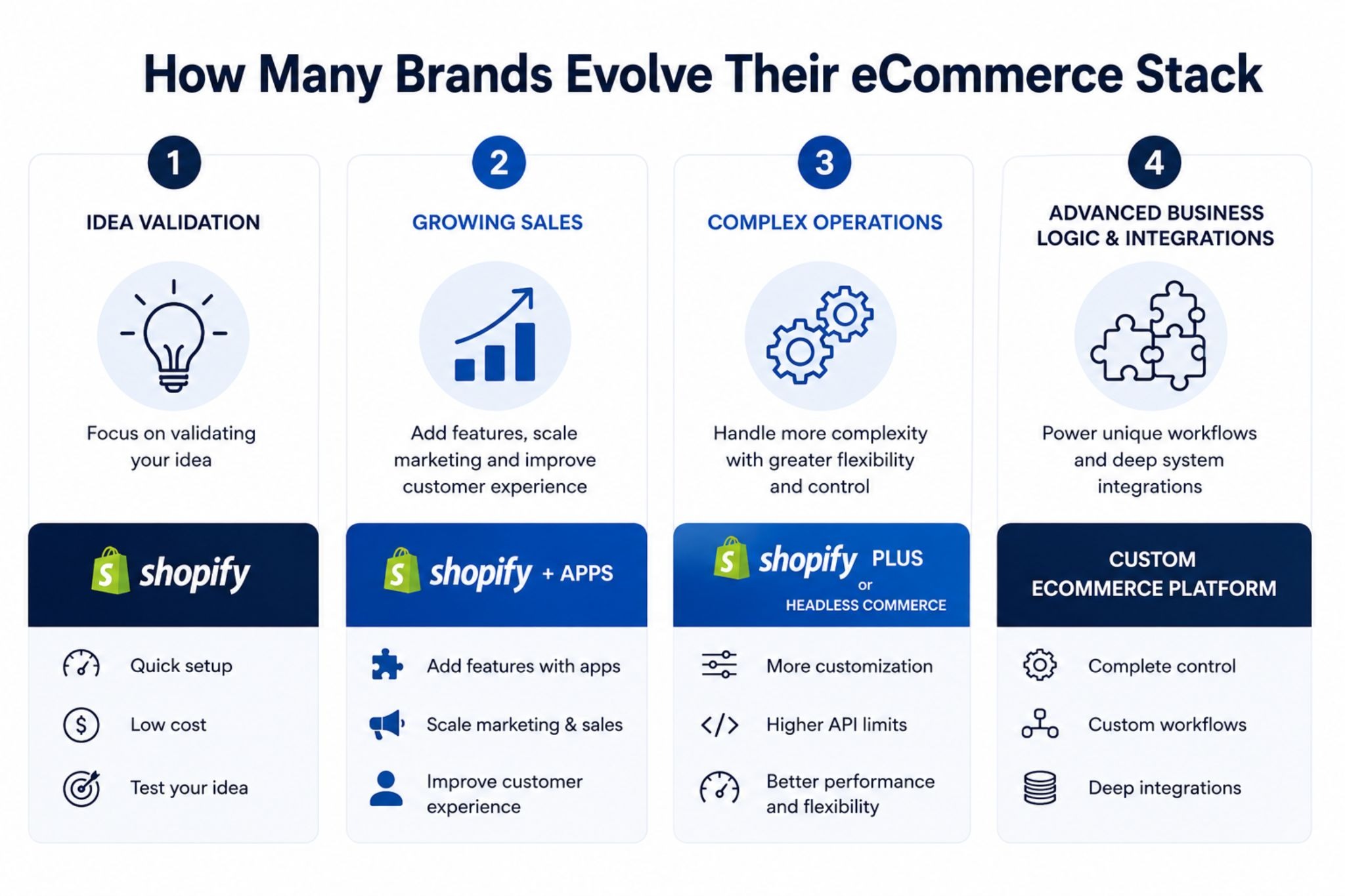
What If You Need Both? (Headless Commerce)
Many growing brands keep Shopify running in the background; it handles inventory, orders, and payments, and the team already knows how to use it. But the storefront customers actually see is custom-built.
This setup is called headless commerce. You get Shopify's reliability without being stuck with its theme and checkout limits.
It's more work than a normal Shopify store, and you need a team that knows both Shopify's backend and modern front-end development. That's what a specialist shopify web development company is built for, not a quick theme change.
This path is common for brands that started on Shopify, outgrew the storefront, but don't want to rebuild their entire order system.
If you're in retail and thinking about this kind of setup, choose the right e-commerce development company, one that can put Shopify in the back and something stronger up front.
So, Which One Should You Actually Choose?
Choose Shopify if you're:
Launching a new brand or testing a product line
Selling a fairly standard catalog to consumers
Working without a dedicated in-house dev team
Prioritizing speed over long-term flexibility
Choose Custom eCommerce if you're:
Running complex B2B pricing, configurators, or multi-warehouse logic
Outgrowing what apps and workarounds can fix
Integrating deeply with an existing ERP or CRM
Building something investors or regulators will scrutinize closely
There's no prize for picking the more impressive-sounding option. The businesses that get this right choose based on where they actually are, not where they hope to be in three years.
Still Weighing It Up?
That's normal; this isn't a decision to rush. If you want a second opinion on where your business actually sits.
Tell us what you're building, and we'll give you a straight answer on whether Shopify, custom, or headless actually fits.
FAQs
Can I move from Shopify to a custom site later?
Yes, you can. The important part is planning the migration well, so your SEO rankings and customer data make the move with you instead of getting lost along the way.
Does Shopify limit my SEO?
To some extent, yes. You don't get full control over your URL structure, and running too many apps can slow your site down. Both of those affect how well you rank.
What is headless commerce, in plain terms?
It's a setup where Shopify quietly handles the backend: orders, inventory, and payments, while a custom-built front end is what your customers actually browse and shop on. You get Shopify's reliability with a storefront built exactly the way you want it.
Is Shopify Plus the same as a custom build?
Not quite. Plus removes some restrictions and gives you more checkout flexibility, but underneath it all, you're still working within Shopify's platform.
Which one is better for a brand-new business?
For most new businesses, Shopify is the better starting point. Getting to market fast matters more early on than having complete platform flexibility.