How Software Development Companies Build Custom Business Solutions That Solve Real Business Challenges

There comes a time in the life of every growing business when things stop going as smoothly as they used to.
What used to work well slowly becomes a problem with operations. Teams now spend more time managing processes, which slows down decision-making and breaks up data.
And the hardest part? Nothing seems "broken enough" to need fixing right away.
A lot of businesses are trying to solve complicated, changing problems with generic tools, but that doesn't work very well in today's digital world.
Reports from the industry say that businesses now use an average of 100 or more SaaS apps, but a lot of business data is still stuck in silos. This has a direct effect on productivity, decision-making, and growth.
This is why more and more forward-thinking companies are choosing to hire a software development company to make custom solutions that fit their business needs.
What Are Custom Business Solutions?
Custom business solutions are software systems designed specifically for a company’s workflows, goals, and operational challenges.
Unlike off-the-shelf tools built for broad use, custom software development focuses on aligning technology with a business's actual functions.
These solutions may include:
Workflow automation systems
CRM platforms tailored to business processes
Data analytics and reporting dashboards
AI-driven automation tools
and Custom web and mobile applications
Instead of forcing teams to adapt to software, these systems are built to adapt to the business.
Business Challenges Companies Are Facing in 2026

The way businesses work has changed in 2026. Some of the most important problems are:
Tool Overload Without Integration
Organizations rely on multiple platforms, but most operate in isolation, creating inefficiencies.Data Availability Without Clarity
While businesses collect more data than ever, turning that data into actionable insights remains a challenge.Scaling Complex Operations
Growth introduces layers of complexity that traditional systems struggle to handle.Unstructured AI Adoption
Many companies are investing in AI without a clear roadmap, leading to limited ROI.Increased Security and Compliance Requirements
Expanding digital systems brings higher risks and stricter regulatory expectations.
These are not short-term issues; they require structured, scalable business software solutions.
Why Businesses Need Custom Business Solutions
Standardized tools serve well in the early stages, but as operations grow, limitations begin to surface.
Businesses often experience:
Increasing reliance on manual workarounds
Duplicate and inconsistent data across systems
Delays in processes and decision-making
Low adoption of existing tools
At this stage, the problem is the misalignment between the tools and the business, and this is where custom software solutions create real value.
How a Software Development Company Builds Custom Solutions
A reliable software development company approaches development with a clear focus on business outcomes.
Understanding the business, not just the requirement: The process begins with analyzing workflows, identifying inefficiencies, and understanding the business requirements.
Translating challenges into structured systems: Business problems are mapped into practical solutions; for example, manual reporting becomes automated dashboards, and disconnected processes become unified systems.
Choosing the right technology stack: The focus remains on scalability, integration, and long-term maintainability.
Designing for usability: Solutions are built to be intuitive, ensuring teams can adopt them without friction.
Developing iteratively: A step-by-step approach allows continuous feedback, testing, and refinement.
Ensuring seamless integration: Systems are designed to work with existing tools like CRMs, ERPs, and analytics platforms.
Testing in real-world conditions: Performance, security, and usability are validated before deployment.
Continuous improvement: Post-launch, the system evolves based on real usage and business needs.
Measuring business impact: Success is defined by outcomes, time saved, cost reduced, productivity improved, and customer experience enhanced.
Softuvo follows this approach to ensure that custom software development delivers measurable business value, not just functional software.
Best Custom Solutions
Modern organizations invest in a range of business software solutions, including:
Enterprise Resource Planning (ERP) systems
Customer Relationship Management (CRM) platforms
Data analytics and business intelligence solutions
AI-powered automation systems
Custom web and mobile applications
Workflow and process automation tools
Each solution is designed to solve specific operational challenges, rather than applying a one-size-fits-all approach.
How These Solutions Solve Real-World Challenges
Custom solutions improve operations by directly addressing common business inefficiencies:
Manual reporting is replaced with automated dashboards, enabling faster and more accurate insights
Disconnected tools are unified into integrated systems, ensuring consistent data flow
Delayed decision-making is improved through real-time analytics, allowing quicker, data-driven actions
Repetitive tasks are automated, reducing manual effort and operational errors
Customer data is centralized through CRM systems, improving visibility and engagement
Benefits of Custom Business Solutions
Investing in custom software solutions offers long-term advantages:
Improved operational efficiency
Faster and more accurate decision-making
Scalability aligned with business growth
Reduced dependency on multiple disconnected tools
Enhanced user experience and adoption
Stronger competitive positioning
While the initial investment may be higher, the long-term return in efficiency and control makes it a strategic decision.
Custom Software vs Off-the-Shelf Tools: What’s Right for Your Business?
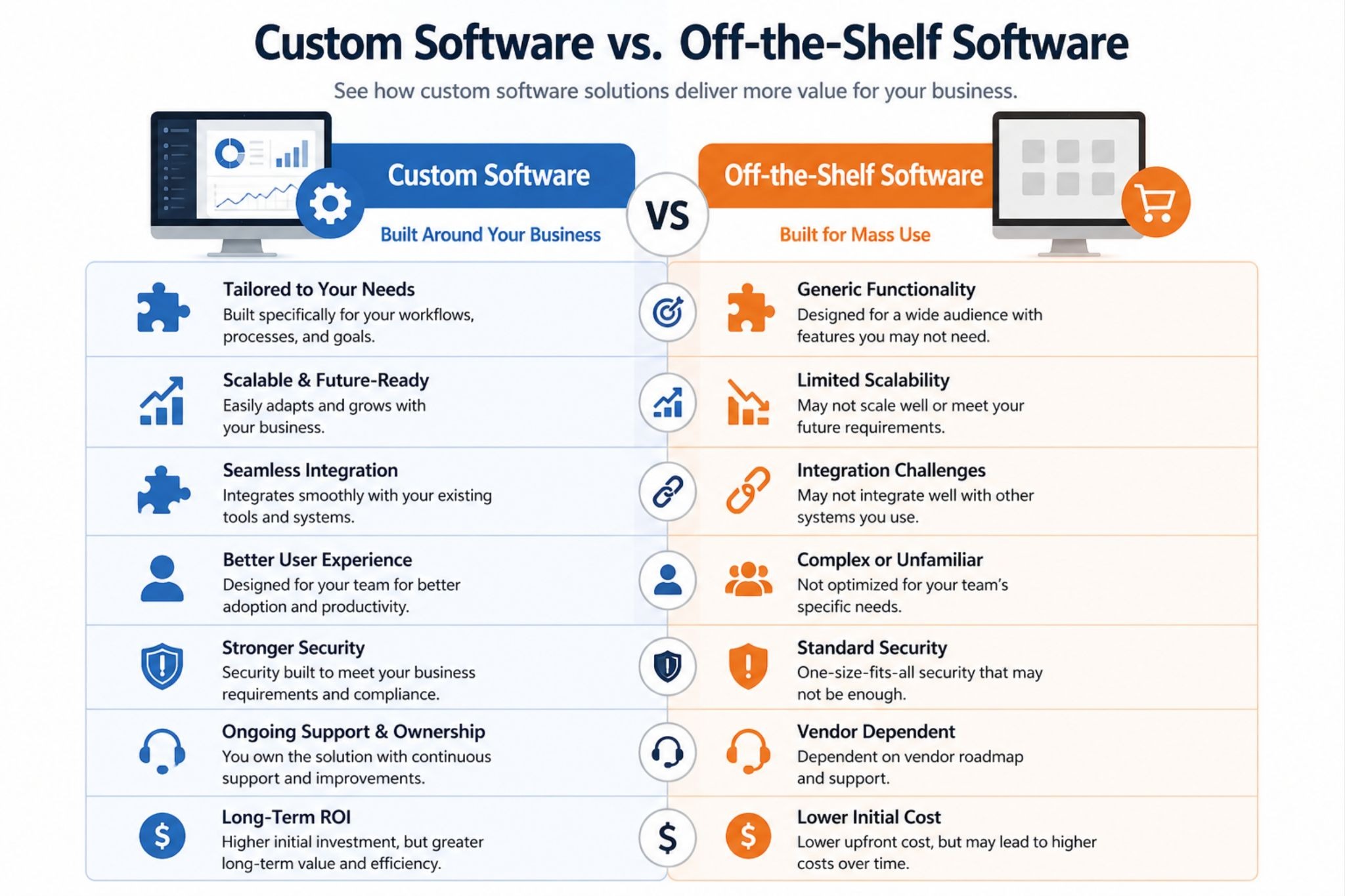
Businesses often face a key decision: whether to use off-the-shelf software or invest in custom development.
Off-the-shelf solutions:
Faster to implement
Lower upfront cost
Limited flexibility
Custom software solutions:
Related to business needs
Scalable and adaptable
More efficient in the long run
Final Thoughts
Not the businesses that use the most tools, but the ones that use the right systems made for their needs are the ones that do well today.
Choosing to hire a software development company is not just a technical decision, but it’s a strategic one. It’s about building solutions that align with how your business operates today and how it will evolve tomorrow.
Because at the end of the day, software is more than just what it can do. It's about making systems that make things clear, work better, and help businesses grow in a way that lasts.
Custom software development
Custom software, built to fit the way your business works
Softuvo scopes, designs and delivers custom web platforms and internal tools, with low-code options where speed matters more than bespoke code.
Prefer email? Write to [email protected] or use the contact form.