Fleet Route Management & Dynamic Route Optimization Explained
In today’s logistics landscape, speed alone is not enough. Precision, adaptability, and real-time intelligence now define success. For companies managing deliveries across cities, states, or countries, fleet and route management has evolved from a basic operational task into a strategic growth driver.
As we move deeper into 2026, businesses are no longer asking, “What’s the shortest route?” Instead, they are asking, “What’s the smartest route right now?”
With rising fuel prices, stricter emission regulations, customer expectations for real-time tracking, and the rapid expansion of e-commerce, investing in modern fleet management software is no longer optional; it’s essential.
Let’s explore how logistics fleet optimization, AI-driven route optimization, and GPS fleet tracking are reshaping the industry.
The Growing Importance of Fleet and Route Management
The global fleet management market continues to expand rapidly. Industry reports project the market to grow from approximately $23.8 billion in 2025 to over $27 billion in 2026, maintaining a CAGR of around 14–15%.
This growth is not driven by more vehicles alone; it reflects a major shift toward intelligent systems that can analyze, predict, and optimize operations in real time.
At its core, fleet and route management involves:
Monitoring vehicle performance
Planning and optimizing delivery routes
Tracking driver behavior
Managing fuel efficiency
Ensuring regulatory compliance
In 2026, data, automation, and artificial intelligence will be the driving forces behind this process.
Why Traditional Route Planning No Longer Works
In the past, route planning was a static process. Dispatchers would print schedules each morning, drivers adhered to fixed routes, and any necessary changes had to be managed by hand.
That model simply cannot survive in today’s environment.
Consider these real-world challenges:
Sudden traffic congestion
Road closures
Extreme weather events
Last-minute delivery changes
Tight customer time windows
A fixed plan cannot adapt to dynamic realities. This is where advanced fleet management software bridges the gap between planning and execution.
The Real Cost of Poor Logistics Visibility
Without an integrated system, fleet operations suffer in three major areas:
1. Fuel Inefficiency
Fuel represents one of the highest operational costs for logistics companies. Studies show that inefficient routing, idling, and empty return trips (deadhead miles) can consume up to 30% of transportation budgets.
Even small route inefficiencies multiply quickly across large fleets.
2. Data Silos
Vehicle diagnostics, GPS tracking, maintenance logs, and driver performance data often exist in separate systems. When data is disconnected:
Decisions are slower
Maintenance is reactive instead of predictive
Visibility is limited
Modern logistics fleet optimization eliminates these silos by centralizing data.
3. Customer Dissatisfaction
Research on last-mile delivery reveals that inaccurate ETAs are among the top reasons for customer complaints.
Today’s customers expect “Uber-like” visibility. If they cannot track their shipment in real time, trust drops immediately.
AI-Driven Route Optimization
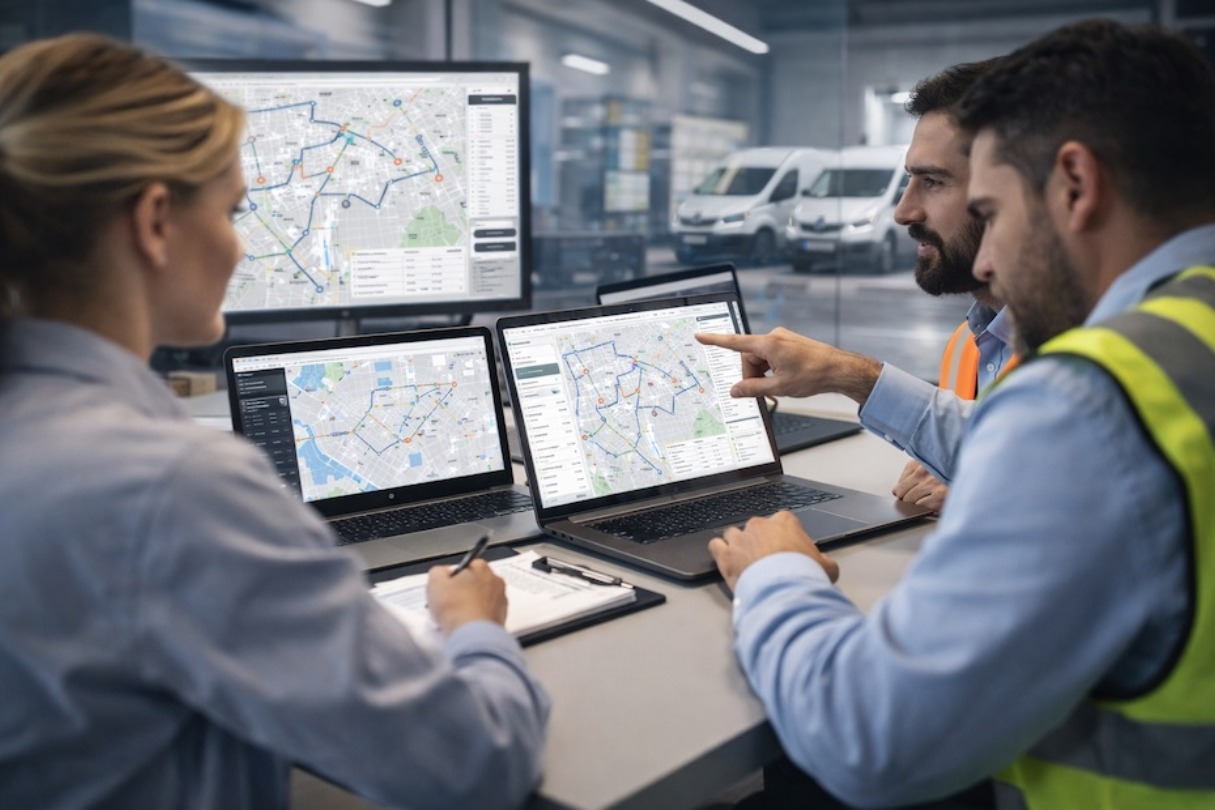
The most powerful innovation in fleet and route management today is AI-driven route optimization.
Unlike traditional GPS systems that simply calculate the shortest distance, AI evaluates thousands of variables simultaneously.
What AI Considers:
Historical traffic patterns
Real-time congestion data
Weather forecasts
Delivery priority windows
Vehicle weight and size restrictions
Fuel consumption patterns
Driver availability and legal driving hours
This intelligence allows the system to constantly adjust routes throughout the day, not just once in the morning.
Measurable Impact of AI in Fleet Operations
Companies implementing AI-driven route optimization have reported impressive results:
Up to 35% reduction in total transportation costs
20–30% decrease in fuel consumption
40% reduction in vehicle downtime through predictive maintenance
Improved on-time delivery rates exceeding 95%
These are not minor improvements; they have a direct impact on profitability.
AI transforms logistics from a cost center into a competitive advantage.
The Strategic Role of GPS Fleet Tracking
If AI is the brain of modern fleet systems, GPS fleet tracking is the eyes.
But GPS today is far more advanced than simply showing a vehicle’s location.
Modern GPS-enabled fleet management software provides:
Real-Time Visibility
Dispatchers can monitor every vehicle’s position and status instantly.
Driver Behavior Insights
Harsh braking, rapid acceleration, and excessive idling can be tracked and corrected, improving both safety and fuel efficiency.
Geofencing
Automated alerts trigger when vehicles enter or exit specific zones. Warehouses can prepare loading docks as trucks approach, minimizing delays.
Dynamic Reassignment
If one driver is delayed, the system can automatically assign deliveries to a nearby vehicle, preventing missed deadlines.
This real-time adaptability is central to effective logistics fleet optimization.
Real-World Scenario: Static vs. Dynamic Routing
Let’s imagine a regional distributor operating 50 refrigerated trucks.
Static System
A bridge unexpectedly closes.
A truck gets stuck in traffic for two hours.
Perishable goods risk spoilage.
The driver exceeds legal driving hours.
Multiple deliveries are delayed.
Losses multiply quickly.
AI-Driven Dynamic System
The system detects the closure in advance.
An alternative route is instantly calculated.
Two deliveries are reassigned to a nearby truck.
Delivery windows are maintained.
Fuel waste is minimized.
Result:
Zero spoilage
On-time delivery maintained
Operational costs reduced
This is the real power of modern fleet and route management.
2026 Trends Shaping Logistics Fleet Optimization
Several emerging trends are making advanced systems mandatory rather than optional.
1. Electrification of Fleets
As companies transition to electric vehicles (EVs), route planning becomes more complex. AI must factor in:
Battery range
Charging station locations
Charging time requirements
Traditional route tools are not built for this level of complexity.
2. Regulatory Compliance
Governments are enforcing stricter regulations regarding:
Emissions tracking
Electronic logging devices (ELDs)
Driver hour limits
Integrated fleet management software ensures automatic compliance, reducing legal risks.
3. The “Amazon Effect.”
Customers now expect:
Real-time tracking
Accurate delivery windows
Instant notifications
Without GPS fleet tracking and AI-powered updates, meeting these expectations is nearly impossible.
The Environmental Advantage
Optimized routing does more than reduce costs; it lowers carbon emissions.
By reducing idle time, shortening travel distances, and improving fuel efficiency, companies significantly cut their environmental footprint.
In an era where sustainability is becoming a board-level priority, intelligent fleet and route management supports ESG goals while protecting margins.
Building a Unified Fleet Intelligence System
The most effective logistics operations rely on a unified system that integrates:
GPS fleet tracking
Telematics data
IoT vehicle sensors
Predictive maintenance analytics
AI-driven route optimization
Instead of juggling multiple dashboards, decision-makers get a single source of truth.
At Softuvo, the focus is not just on building software; it is on building intelligent systems to meet business needs. By combining real-time tracking with AI analytics, organizations gain full operational visibility across every asset.
Businesses implementing integrated solutions commonly achieve the following:
Up to 30% reduction in fuel and idle costs
Faster delivery turnaround times
Improved asset utilization
Increased driver safety
Stronger customer retention
Technology should empower operations, not complicate them.
Why Now Is the Time to Invest
The logistics industry is at a turning point.
Rising operational costs, competitive pressure, and evolving customer expectations demand smarter systems.
Delaying investment in advanced fleet management software often results in:
Higher fuel expenses
Increased maintenance costs
Lost customers
Reduced competitiveness
The transition from manual routing to AI-driven route optimization is not simply a software upgrade; it is a complete operational transformation.
Conclusion: Optimize Every Mile
In 2026, successful logistics companies are those that combine visibility, intelligence, and adaptability.
By implementing modern fleet and route management systems powered by AI-driven route optimization and GPS fleet tracking, businesses can:
Reduce costs
Improve safety
Enhance sustainability
Deliver exceptional customer experiences
The road ahead belongs to companies that move smarter, not just faster.
If your organization is ready to strengthen its logistics engine and unlock measurable efficiency gains, now is the time to build a system designed for the future.
Every mile matters. Optimize it wisely.
FAQs
1. What is fleet route management?
Fleet route management is the process of planning, tracking, and optimizing vehicle routes to improve efficiency, reduce costs, and ensure on-time deliveries.
2. What is dynamic route optimization?
Dynamic route optimization uses AI and real-time data to automatically adjust delivery routes based on traffic, weather, and operational changes.
3. How is AI better than traditional route planning?
Traditional routing is static. AI continuously analyzes live data and updates routes to avoid delays and reduce fuel usage.
4. How does GPS fleet tracking improve operations?
GPS tracking provides real-time vehicle visibility, monitors driver behavior, and enables faster decision-making.
5. Can route optimization reduce fuel costs?
Yes. Optimized routing reduces idle time, unnecessary miles, and fuel waste, often lowering fuel costs by 20–30%.