How to Choose a Mobile App Development Company the Right Way

Building a mobile app is a significant investment for any business. Just assume you hired a development company, and six months later, you get a half-built app, a drained budget, and the vendor has gone silent.
It's one of the most common and expensive mistakes businesses make. And the worst part? It's almost always preventable. However, with thousands of development agencies and freelancers offering app development services worldwide, finding the right partner can be challenging.
The goal of this blog isn't to give you a generic checklist. It's to show you exactly where businesses go wrong and how to avoid them before you sign anything.
Why Choosing the Right Development Partner Matters
Missed deadlines, unexpected costs, poor communication, and low-quality code are some of the most common issues businesses face when working with inexperienced or unreliable vendors.
It's rarely the idea or even the technology.
It's about choosing the right mobile app development company, not the one that only knows how to win a contract but doesn’t know how to deliver a product.
Most businesses compare vendors on price and presentation. That's how you end up with a team that looked great in the proposal and disappeared after the first payment.
A reliable development partner will not only build your application but also help you make informed decisions throughout the development process.
6 Red Flags to See When Looking for the Right Mobile App Development Company
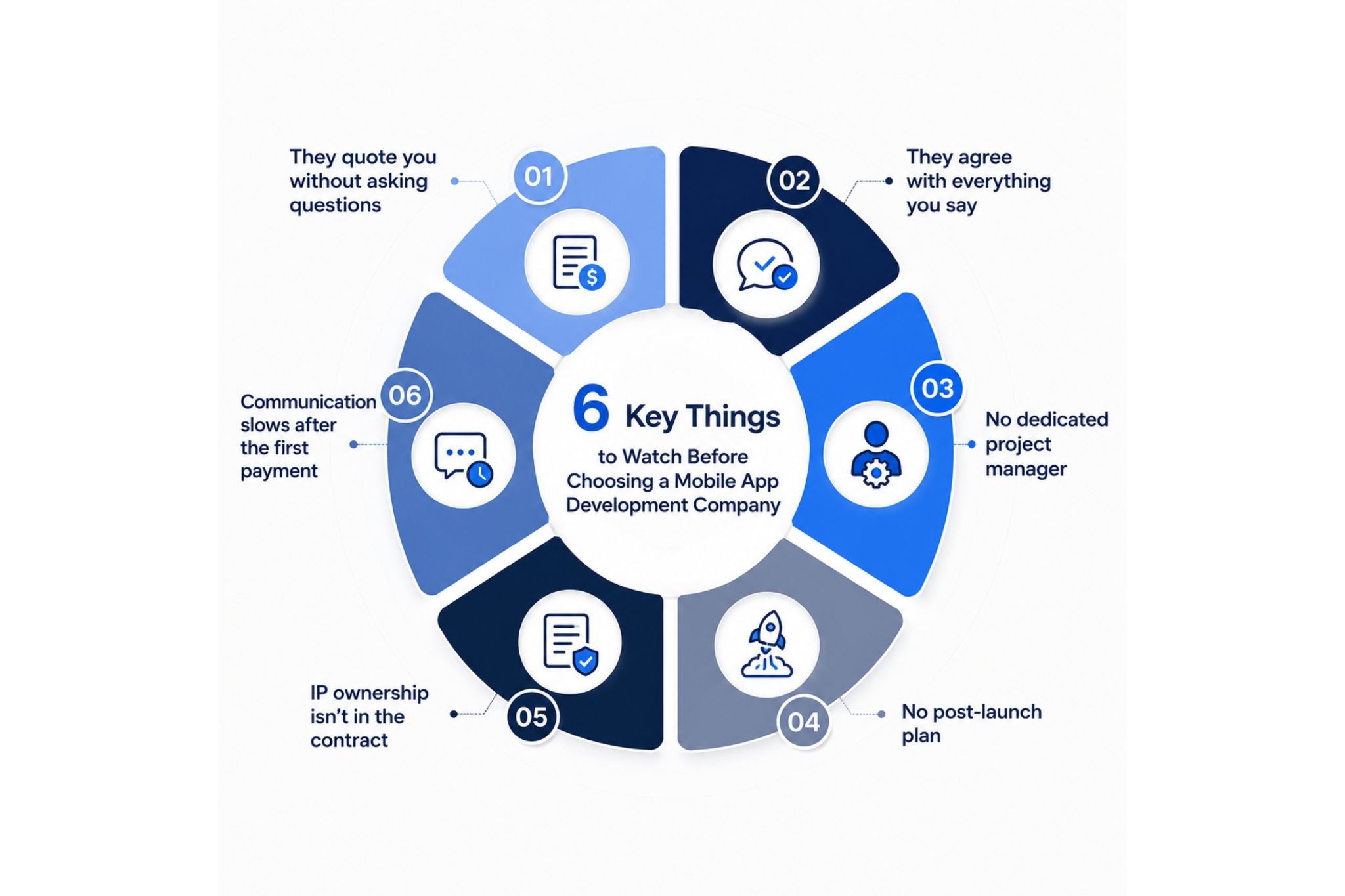
1. They quote you without asking questions
If you get a detailed price within 24 hours of your first email, with no discovery call and no questions about your users or integrations, that's a template, not a quote. The real number will surface after you've already paid a deposit.
2. They agree with everything you say
A strong app development firm pushes back. They'll say, "That feature adds six weeks, and users may not need it; here's what we'd suggest instead. " A team that never challenges your brief isn't being helpful. They're avoiding hard conversations that will become your problem later.
3. No dedicated project manager
If the developer is also your project manager, your account manager, and your point of contact, things will break. You need one person whose only job is to keep the project on track and communication clear.
4. No post-launch plan
Your app will need updates after launch. OS changes, bug fixes, and new features. If post-launch support isn't mentioned early, it either doesn't exist or costs a fortune later. Ask specifically: What's included after go-live?
5. IP ownership isn't in the contract
Who owns the code when the project is done? It should be you, explicitly, in writing. If a vendor hesitates on this or uses vague language like "you'll have access to deliverables," walk away.
6. Communication slows after the first payment
This is less a red flag and more a fire alarm. Set communication expectations in writing before any money moves. A professional team welcomes this.
Questions That Reveal More Than Any Proposal
Most people ask vendors what they can do. The better questions reveal how they actually work.
"Tell me about a project that went over budget or launched late."
Every honest team has one. How they talk about it tells you everything about their accountability and client relationships.
"How do you handle scope changes mid-project?"
Scope creep is the #1 cause of cost overruns. You want a defined process, not "we're flexible."
"Can I speak directly to two past clients?"
The references they hand you are curated. Ask to reach out independently to clients with similar projects. Confident teams say yes immediately.
The Hidden Cost of "Cheap" Development
Choosing the lowest bid is one of the most expensive decisions you can make.
A $15,000 app built by the wrong team often requires $50,000+ in rework within 18 months, not because features stop working, but because the architecture can't scale and the code isn't maintainable.
Add security vulnerabilities. In regulated industries like healthcare or finance, a data breach costs far more than the original development budget ever was.
The real calculation isn't cheap now vs. expensive now. It's cheap now vs. catastrophic later.
If the budget is genuinely tight, build a leaner MVP, but invest in solid architecture from day one. Everything you build later sits on that foundation.
Things to Consider When Working with an Offshore Team
When businesses look to hire mobile app developers globally, offshore teams offer real advantages, accessing deep talent at significantly lower cost. But offshore engagements fail for predictable reasons, and most of them are avoidable.
Time zone overlap matters. A 4–5 hour overlap is workable. Zero overlap means every decision takes 24 hours. That adds up fast over a 6-month project.
Test before you commit. Run a 2-week paid discovery sprint before signing a full development contract. You'll learn more in those two weeks than in ten sales calls.
Verify data compliance. If your app handles user data, and almost every app does, your vendor needs to understand GDPR, CCPA, HIPAA, or whatever applies to your users' markets. They should bring this up. If they don't, you should.
How to Make the Final Call
After shortlisting, here's what actually matters:
Technical fit: Have they shipped real products using your required tech stack?
Process clarity: Can they walk you through their development process without being vague?
Honest communication: After every meeting, do you feel clearer or more confused?
Verified references: Have you spoken directly to past clients, independently?
Clean contract: IP ownership, milestone-tied payments, change management, post-launch support. All of it, in writing.
Taking the time to evaluate vendors carefully may feel slow at the beginning, but it's far less expensive than fixing a failed project later. The right partner helps reduce risk, accelerate development, and build a product that can grow with your business.
How Softuvo fits
When you evaluate Softuvo against the checklist in this article, look for: an honest discussion of staff augmentation, project delivery, or an offshore team; native iOS, Android, or cross-platform engineers from hire developers (for example Swift developers); experience with existing apps through modernization; and clear IP, security, and communication terms. Ask Softuvo the tough questions.
Final Thought
The best app development companies don't just execute a spec. They ask better questions than you do, flag risks before they become problems, and treat the launch as a starting point.
That kind of partnership doesn't come from the cheapest proposal. It comes from doing the diligence upfront.
Ready to have the conversation?
If you're evaluating development partners and want guidance on your project requirements, timeline, or technology stack.
FAQs
How long does it take to build a mobile app?
Simple MVPs take 2–4 months. Mid-complexity apps take 4–8 months. Enterprise platforms can take 12+ months. Be skeptical of anyone promising a complex product unrealistically fast.
Fixed-price or time-and-materials contract: which is better?
Fixed-price works when requirements are clear and stable. Time and materials is better when the scope is likely to evolve. Neither is universally right; it depends on how defined your project is at kickoff.
How do I protect my idea before sharing it with a vendor?
Request a mutual NDA before sharing detailed specs. Any legitimate team will sign one without issue.
How do I know if a company is genuinely one of the best app development companies or just good at marketing?
Ask for independent references. Ask to see apps live in production. Have a real technical conversation with the engineers, not just the sales team. Marketing is easy to polish. Diligence reveals the truth.
How do I choose a mobile app development company?
Define product goals, check domain fit, inspect process and security, interview the actual team, and be wary of vague "cheap and fast" promises.
What are the red flags?
No named team, no questions about your users, a portfolio that doesn't match your needs, and pressure to sign before discovery.
Should I hire dedicated developers or outsource the whole app?
It depends on whether you already have product ownership in-house. See hire dedicated developers.